
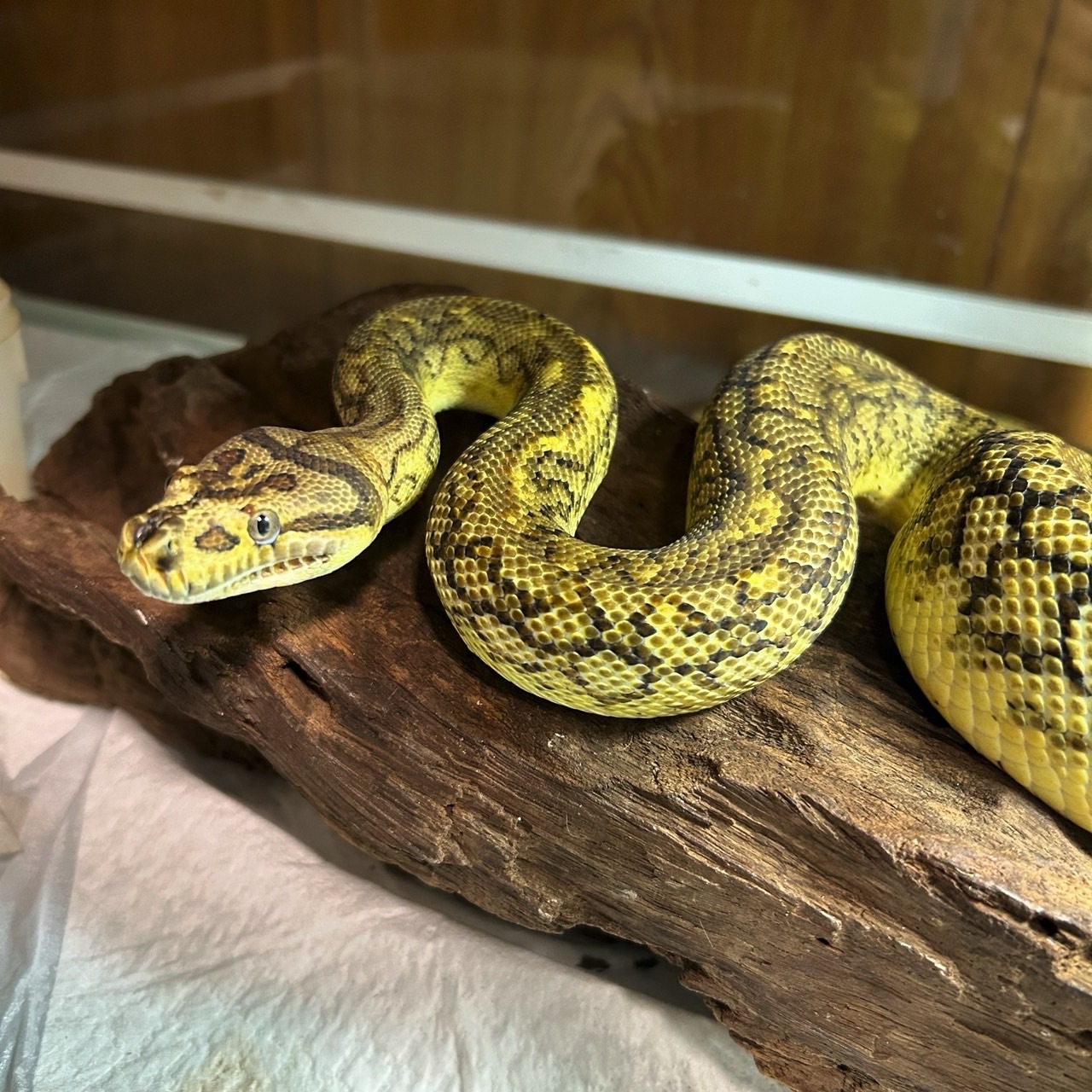
As an Amazon Associate, I earn from qualifying purchases through links in this post.
Carpet pythons go through distinct growth phases, and each stage calls for different housing. The setup that works for a hatchling will stress out a yearling, and what suits a yearling becomes cramped for an adult. This article walks through the enclosures I actually use at each life stage—not as recommendations from a breeder or expert, but as practical choices that have worked across multiple animals over several years.
Hatchlings: First Few Months
Standard clear plastic containers work well for newly hatched carpet pythons. At this stage, these snakes are extremely defensive and spend most of their time hiding. A small, simple enclosure reduces stress more effectively than a spacious setup with elaborate décor.
I use basic clear storage boxes during this period. The transparent walls make it easy to monitor feeding response and behaviour without opening the enclosure. Hatchlings do not need expensive specialty cages. What matters is appropriate size—just large enough for a water dish, hide, and a modest temperature gradient.
My favorite is the Sanko Reptile Box Wide.
Juveniles: Up to One Meter
Once the snake reaches roughly 60–80 cm and begins feeding consistently, I move it to a small terrarium such as the Sanko Pantheon 6035 (60 × 35 cm footprint). Juveniles remain skittish during this phase, and an enclosure matched to body size provides better security than an oversized space.
The Pantheon series is lightweight and has front-opening doors, which make routine maintenance straightforward. Ventilation is adequate without being excessive. At this stage the snake still spends significant time in its hide, emerging mainly at night or during feeding.
Sub-Adults: Around 150 cm
As the snake approaches 150 cm, activity levels increase noticeably. I upgrade to the Sanko Pantheon 6045 (60 × 45 cm) to accommodate more movement. The additional floor space allows the snake to stretch out and explore without immediately encountering a wall.
This is the stage where individual temperament becomes more apparent. Some carpet pythons remain cautious and stay hidden much of the time; others begin patrolling the enclosure regularly. The 6045 provides enough room for both personality types to behave naturally.
Adults: Two Meters and Beyond
Once a carpet python exceeds two meters, standard commercial enclosures become limiting. Ideally, I would use something like the Sanko Pantheon 9045 (90 × 45 cm), but for snakes approaching or exceeding 200 cm, I find that at least 100 cm of horizontal length is necessary.
Commercially available enclosures in that size range tend to be expensive, and not all designs suit carpet pythons well. For my largest adults, I use a custom-built enclosure measuring 100 × 50 × 45 cm. Building your own cage is a viable option if you cannot find a suitable product at a reasonable price. The construction does not need to be complex—melamine panels, sliding glass doors, and proper ventilation holes are sufficient.
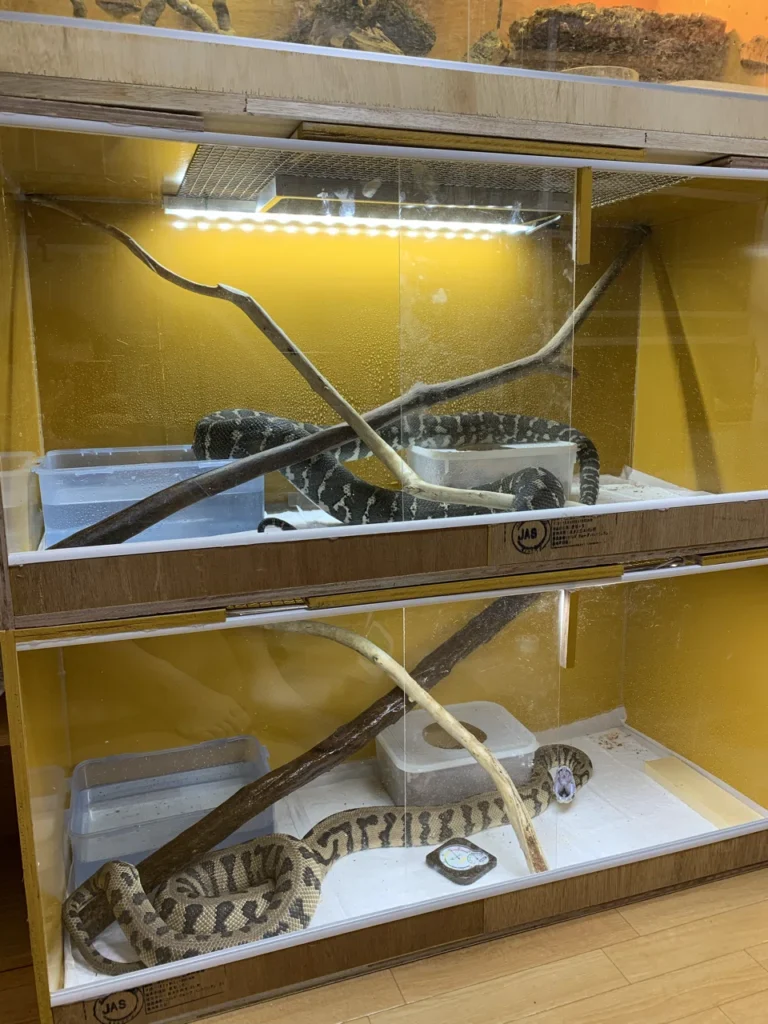
Sizing Guidelines I Follow
The minimum enclosure width I use is half the snake’s total length. For height, I do not go below 45 cm regardless of the species, because carpet pythons—especially jungle carpet pythons (Morelia spilota cheynei)—are semi-arboreal and benefit from vertical space.
Jungle carpets in particular are active snakes. They climb, patrol, and move considerably more than many other python species. Enclosures that meet only the bare minimum dimensions often lead to underexercised, overweight animals. Providing adequate space is one of the simplest ways to prevent obesity, which is a common issue in captive carpet pythons.
Common Sizing Mistakes
Moving a snake into an enclosure that is too large too soon can backfire. Sub-adults placed directly into an adult-sized setup often hide for extended periods, feed irregularly, and show signs of stress. Upgrading enclosure size incrementally as the snake grows tends to produce more settled animals than jumping straight to a large cage.
The opposite mistake is keeping a large snake in an enclosure that is too small for too long. A two-meter animal can be housed in a 90 cm enclosure for short periods, but over months the lack of room to move can affect muscle condition and make feeding response less reliable. Giving the animal adequate space generally resolves these issues.
A Note on Variability
Carpet python growth rates vary by subspecies, feeding schedule, and individual genetics. A jungle carpet python may remain under two meters for life, while a coastal carpet python (Morelia spilota mcdowelli) can exceed 2.5 meters. The enclosure sizes mentioned here are based on animals in my own collection, which includes jungle and coastal carpet pythons. Adjust based on the specific animal, not just its age.
Housing decisions also depend on available space, budget, and how many snakes you maintain. What works in my setup may not translate directly to someone else’s situation. The principle that matters is matching enclosure size to the snake’s current dimensions and activity level, not to a rigid schedule or product list.