
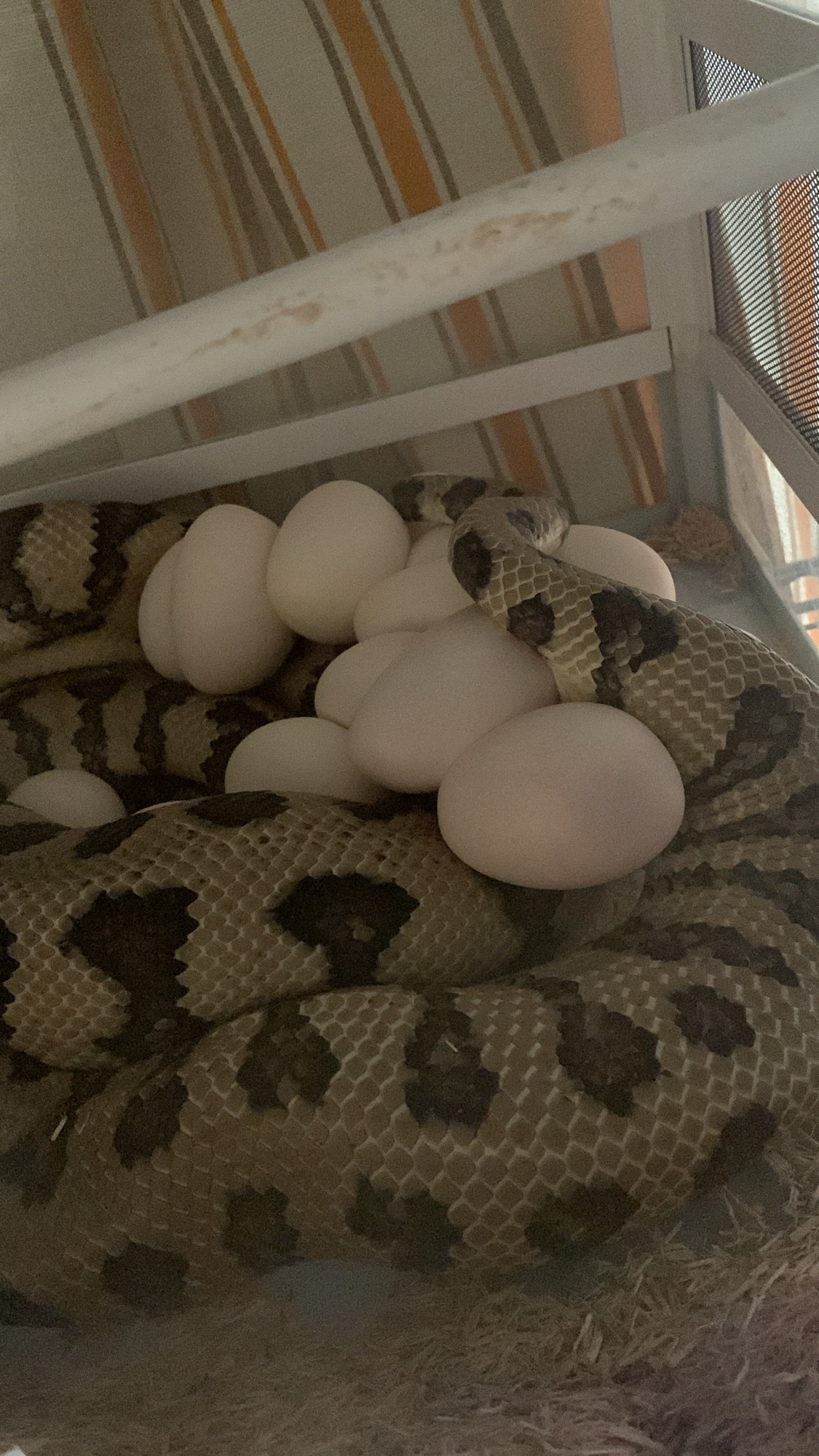
The carpet python (Morelia spilota) is a medium-sized python from Australia, Indonesia, and Papua New Guinea, reaching 2–3 m (6.5–10 ft) as an adult. It belongs to the family Pythonidae, genus Morelia. What follows is a care guide built on my own keeping experience — a fair amount of it is personal opinion rather than settled consensus, and I’ve flagged it as such where it matters.
Temperament and Arboreal Habits
Carpet pythons are generally even-tempered, but temperament varies a good deal by locality and with age. Jungles and juveniles can be nippy, and any carpet can bite — a bite from a 2 m animal draws real blood — so handle with the right technique and respect. With consistent, informed handling most settle into a handleable snake. “Handleable” is not “won’t bite,” though; treat every carpet as capable of it.
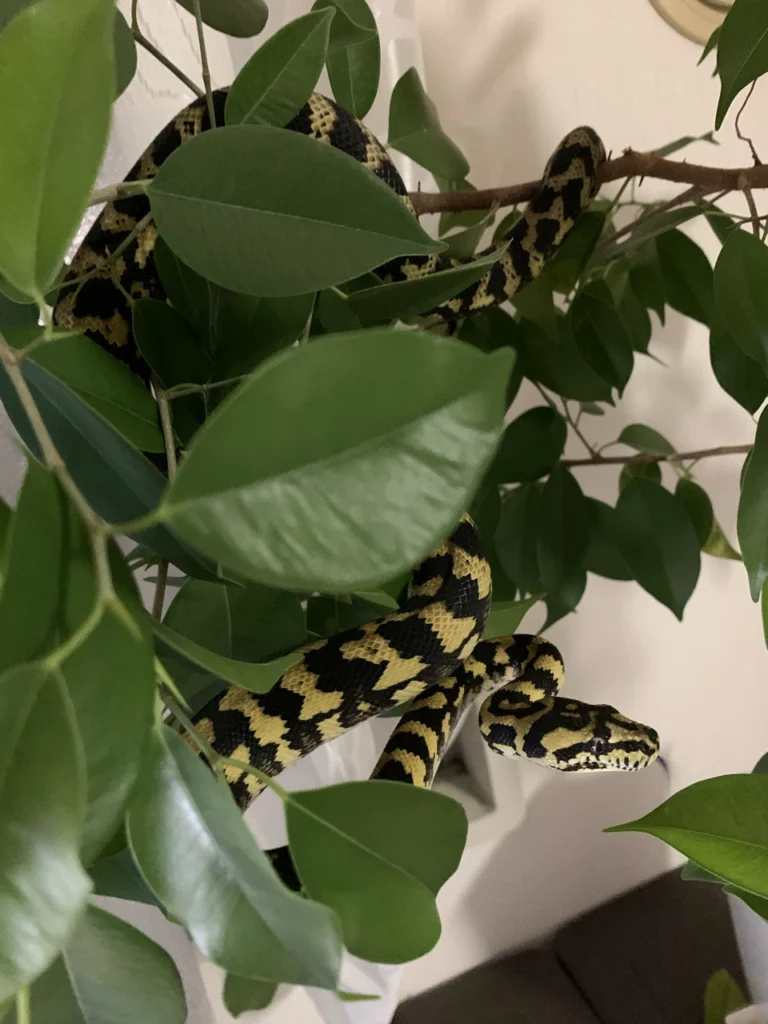
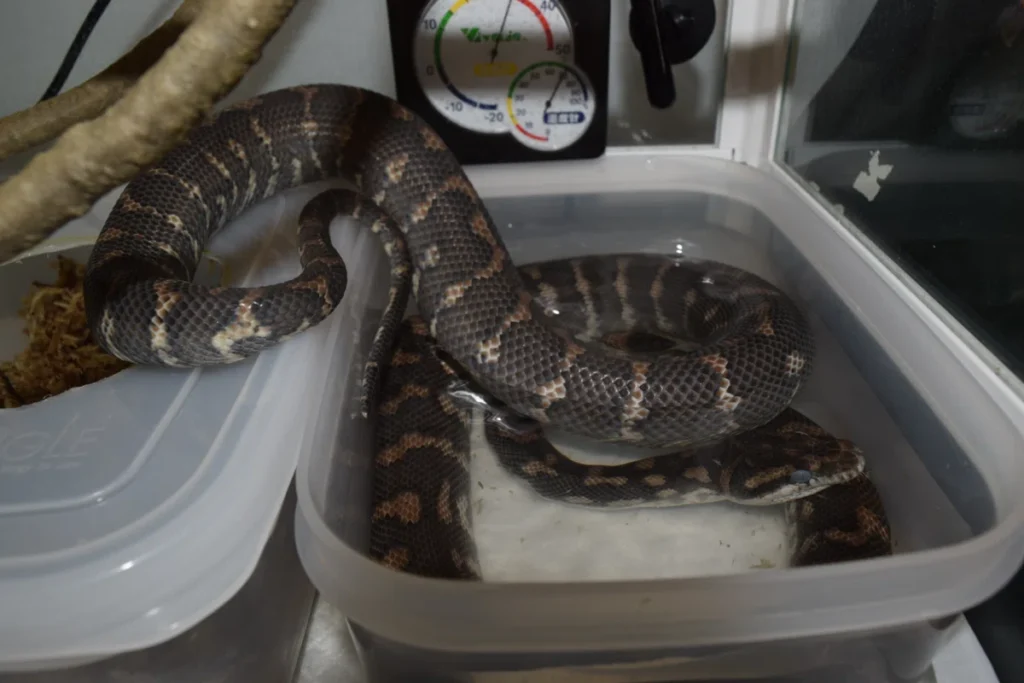
They’re usually described as semi-arboreal, but in my experience the balance shifts by locality. Coastals tend to stay terrestrial and don’t move around much; Jungles are strongly arboreal and often live up on the branches; Irian Jayas also lean arboreal. My own Jungle is on its climbing branch almost all the time — I see it on the ground far less often than up top. A Jungle framed against a branch is a genuinely good-looking snake.
Housing
Enclosure Size
There are plenty of opinions on caging; here’s mine, from experience. From hatchling up to young size (~1 m / 3 ft), carpets are extremely wary, and a too-large enclosure tends to stress them rather than help. Through the young stage I’d use something around 60 × 35 cm (24 × 14 in).
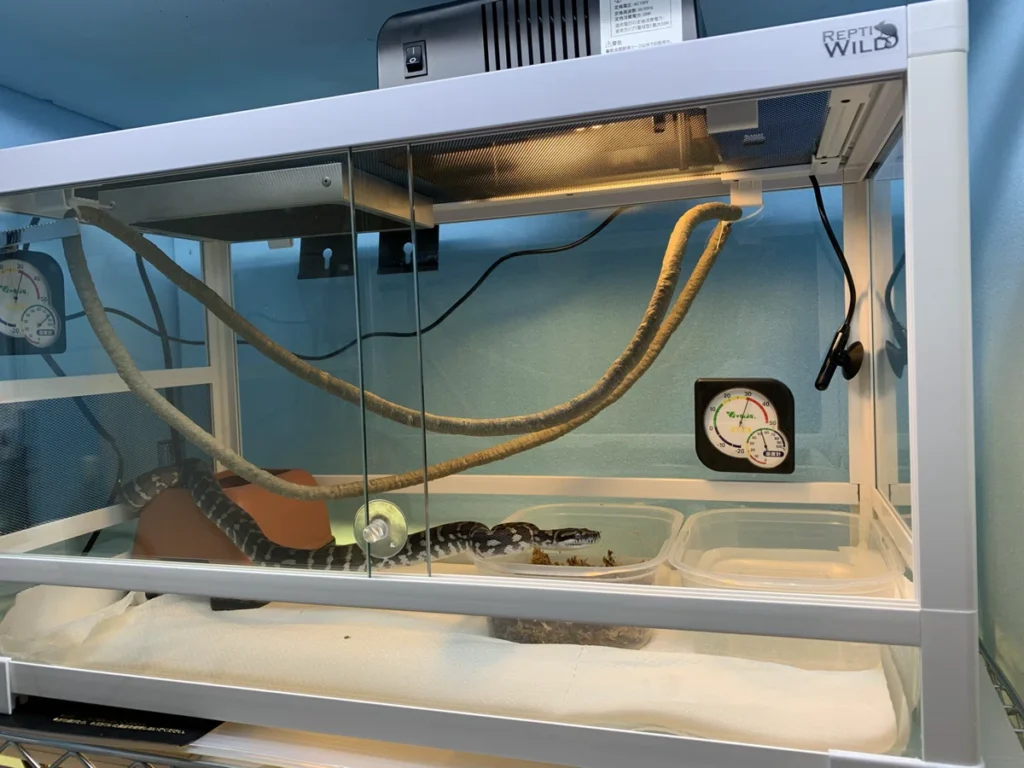
Once they pass semi-adult size (over ~150 cm / 5 ft), move up to roughly 90 × 45 cm (36 × 18 in). You’ll hear that smaller subspecies like Jungles and Inlands can be kept in 60 × 45 cm — I don’t recommend it. The risk is obesity from lack of movement, which harms adult health. Jungles in particular are highly arboreal and active; without room to move around, that kind of animal tends toward obesity and stress.
My ~2 m animals live in a custom enclosure at 100 × 50 × 45 cm (39 × 20 × 18 in). Substrate is a pet pad in summer and husk chips in winter. One hard-won note: use acrylic at least 3 mm thick — a carpet will bend anything thinner and let itself out. (Yes, really.)
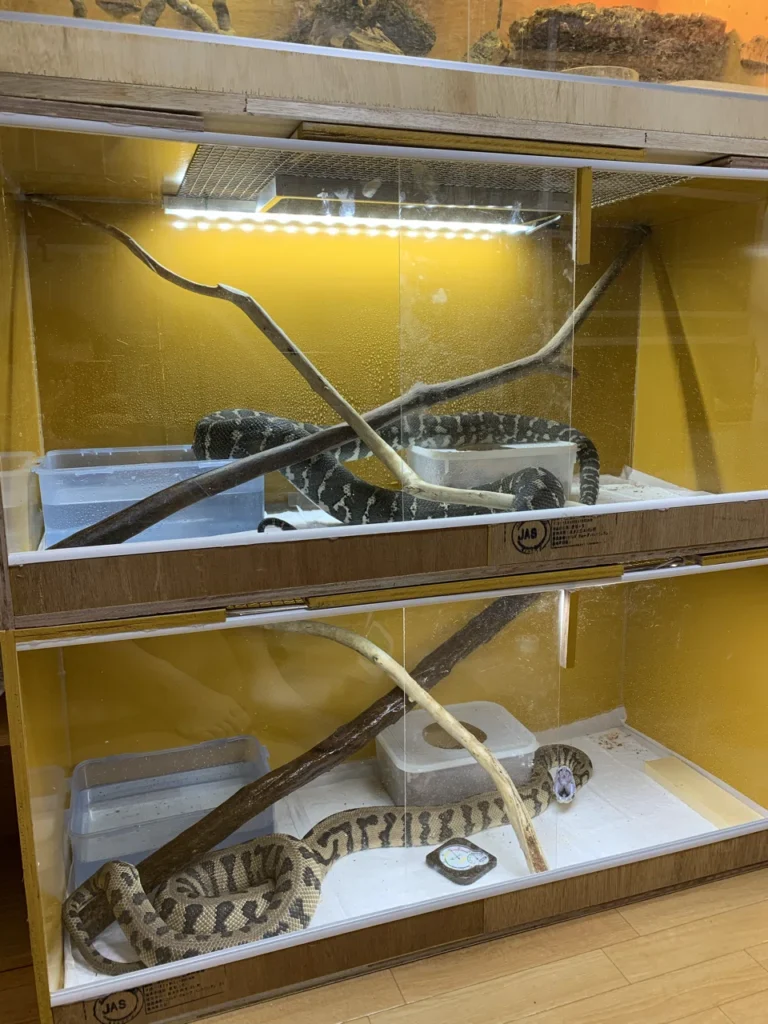
Whether you need to go past a 90 cm enclosure depends on the individual. My own rule of thumb: enclosure width at least half the snake’s length, height at least 45 cm. You can keep a carpet in a 90 cm enclosure and make up the difference with regular supervised time out of the cage — but that means reading the animal’s condition and adjusting its exercise, and frequent handling is itself a stressor. It works, but it asks for a sharp eye and some experience.
Temperature and Humidity
The common recommendation is around 28–30 °C (82–86 °F) and about 60% humidity, with a heat source plus a panel heater warming part of the floor in winter. Personally, I think that runs a little cool and dry.
My own targets: 30–32 °C (86–90 °F), and humidity kept at 60% as a floor, not a ceiling. Carpet pythons are prone to respiratory illness — colds and pneumonia that slide into food refusal. I’ve let carpets catch cold more than once, and the lesson each time was that humidity matters even more for this species than for most snakes. More on colds in the health section below.
Layout: The Climbing-Branch Question
The other thing worth thinking about is layout, and for carpets the real question is whether to include a climbing branch. There’s a well-known claim in Japanese keeping circles — I first heard it credited to the editor of a reptile magazine — that adding a climbing branch makes a snake more aggressive. Is it true? There’s something to it.
The logic runs like this: to get the snake out you have to peel it off the branch, which it dislikes; over time it comes to associate your hands with something unpleasant, and a snake that’s regularly handled against its will gets shorter-tempered. And you do have to get it out for maintenance.
What I did was design the layout so I can do maintenance with the snake left in place on its branch, and when I do take one out, I wait for it to come out on its own rather than pulling it. The result? Some still bite. But I think it’s better for the animal’s stress levels, and — whether because of this or not — a few of mine stopped biting as they matured. A carpet can reach 2.5 m; you really want it to have learned that hands aren’t food before it gets there, or cohabitation gets rough.
Day-to-Day Care
Feeding
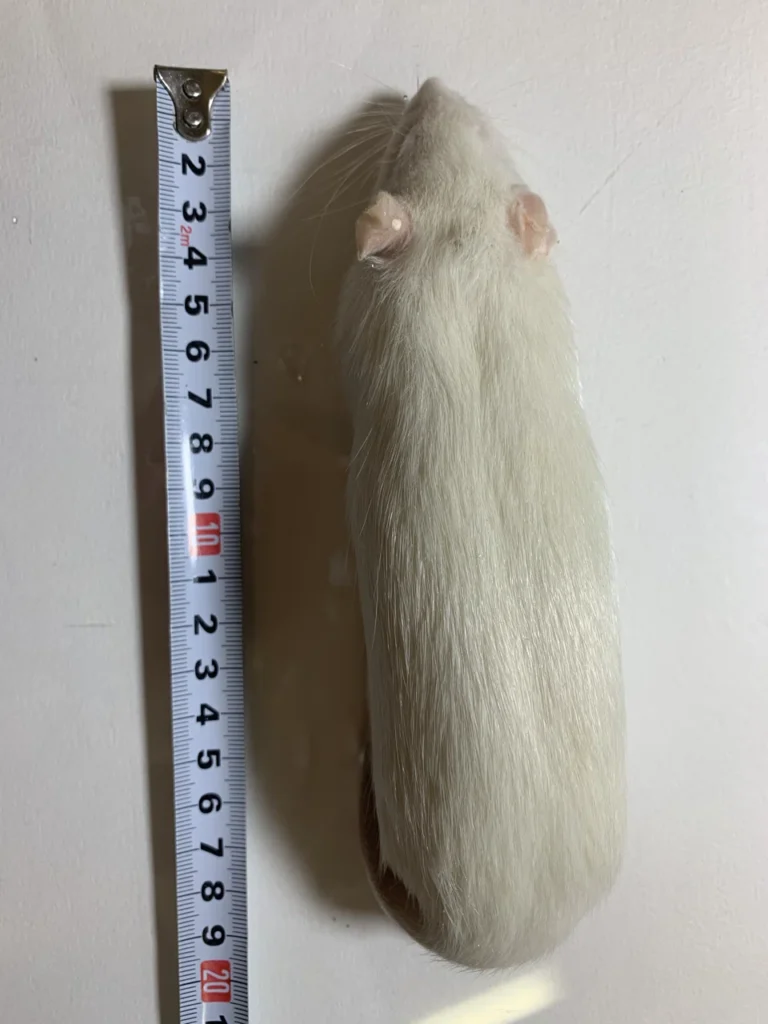
Mice up to the young stage, rats once they’re larger; some keepers move to guinea pigs for animals past full adult size. Individual preference varies — some carpets will only take mice, some only live prey. If you end up with one that insists on live, keep it only if you’re prepared to supply live food. There are also reports of raising carpets to adulthood on processed meat such as chicken breast dusted with vitamins and calcium. Feeding is still very much an area where individual keepers are experimenting; the honest answer is that a lot isn’t settled. Worth testing, within limits that don’t stress the animal.
Water
Always provide a water dish. Carpets drink from it and like to soak, so give one large enough for the whole body and change the water often. I’d also suggest a sphagnum-moss hide: this species is sensitive to humidity swings, and when cage humidity drops I’ll often find a carpet tucked into the moss. The general principle is to give the animal plenty of options inside the enclosure. Before a shed especially, you’ll usually find them soaking.
Misting
Mist at least once a day if you can — humidity matters for this species. Mine also drink the droplets running down the enclosure walls; instinctively they seem to prefer moving water to standing water, at least mine do, which is one more reason misting earns its place.
Cleaning
Spot-clean immediately after a defecation, and clean the whole enclosure about weekly even when there hasn’t been one. Without waste, the substrate can look clean while a high-humidity setup is quietly growing bacteria. I wipe the enclosure down with a hypochlorous acid solution (HOCl) at each clean; building that sanitizing step into the routine is worth it.
Health: Respiratory Illness
Carpet pythons are known for weak respiratory systems. Let temperature or humidity fall and they catch cold fairly easily. A snake’s cold isn’t very different in symptoms from a human’s, but a snake’s immune system isn’t as strong, so a cold here is a potentially life-threatening illness. From the middle stage on, carpet colds tend to bring on pneumonia. Here’s how it tends to present, stage by stage.
- Early. Increased drooling and lethargy; some animals go off food. Catching it this early takes close, regular observation.
- Mid. The early signs worsen. Saliva increases, and the snake wipes it on the enclosure walls, so the sides get dirty. Early pneumonia sets in — a wheeze on the breath — and yawning increases as breathing gets harder. Chronic yawning is worth reading as a sign that something’s off. The animal is lethargic and often still refusing food, and it’s in real trouble. At this point it needs a vet, or it worsens and can die.
- Late. Everything from the mid stage, further along, with the body wasted from prolonged food refusal. Recovery from here is very hard. Even with assist- or force-feeding, whether it holds the food down comes down to luck. You want to treat well before this.
Treatment
If you suspect a cold, the safer move is to raise temperature and humidity. Get to a vet as soon as you can — but there are things to do in the days before you get there. In my experience: bring the temperature up to around 33 °C (91 °F). Higher heat also breeds bacteria faster, and the enclosure is likely soiled with saliva, so clean more often. Raise humidity to around 80%. Carpet respiratory illness is, in most cases, driven by insufficient heat and humidity, so raising both is meant to slow it down.
Closing Thoughts
That’s a run through carpet python keeping. It isn’t everything, and I’ve deliberately packed in a lot of personal opinion. There’s plenty you only learn by keeping one — things you won’t turn up by searching, that you have to develop a feel for. However much information you gather, in the end it comes down to what works for that particular animal. The more of us compare notes, the better we all get at reading them.