
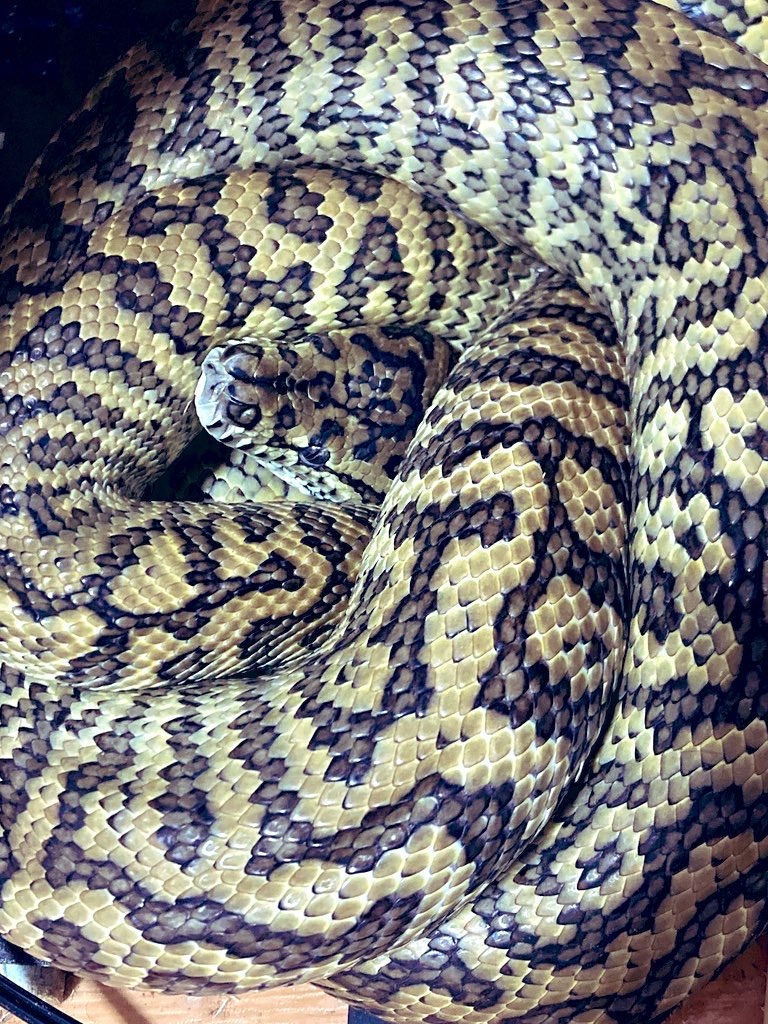
I have kept carpet pythons for about ten years now. It started because I liked Australian animals to begin with — I have actually traveled to Australia twice. The wildlife of that continent has a character you find nowhere else, and the carpet python is one part of it.
Over these ten years, I have taken on not just keeping but breeding, twice. To be honest, neither could be called a complete success. Egg management is hard, and I lost more than I would have liked. Even so, I was able to leave behind a beautiful Caramel Zebra Jaguar. What worked and what did not both sit behind this article.
The reason I wanted to write this guide is simple: there is surprisingly little material that pulls the localities and morphs of carpet pythons together in one place. This is true in English and in Japanese alike — the subspecies discussion, the morph discussion, the genetics, the naming, all scattered around. As a keeper I ended up looking the same things up again and again, thinking “wait, what was this again,” and I decided I might as well put it together properly for once.
Let me say up front that I am not a professional breeder, nor a researcher. I am just one keeper who has kept many species for a long time. So this article contains not only settled facts but also views drawn from experience, and things that are still not well understood. Where I do not know, I write that I do not know. I think that is the more honest way.
The carpet python is a species whose world of subspecies and morphs runs very deep, and at times invites confusion. I hope this guide can serve as a map for grasping the whole picture.
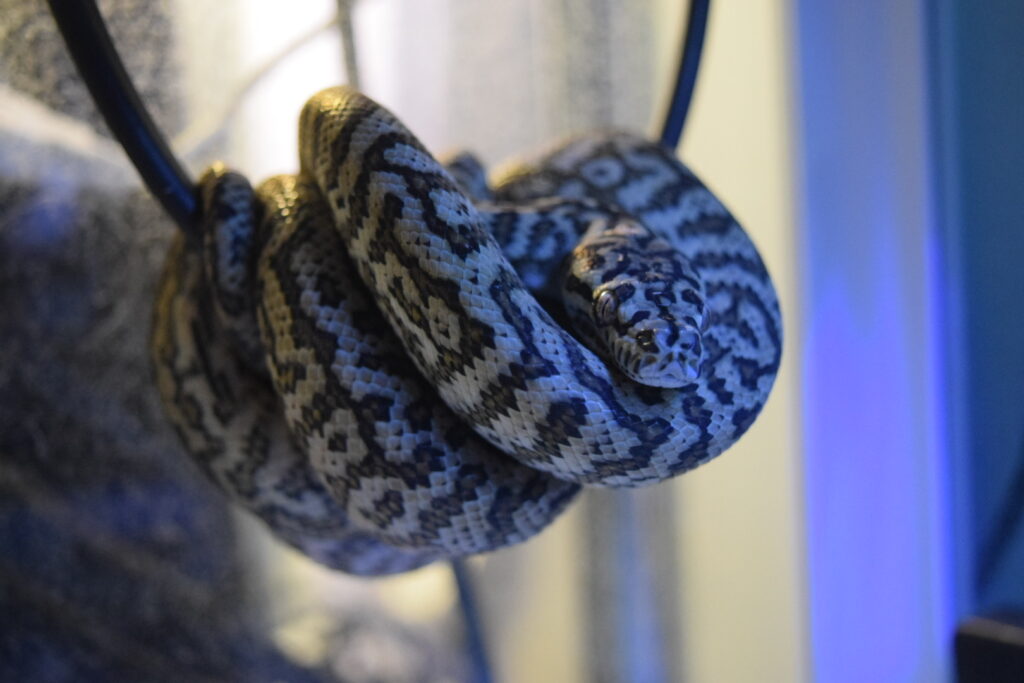
Locality and Morph — What Is the Difference, First
Before getting into individual subspecies and morphs, there are two words I want to separate out at the very start: “locality” and “morph.” These two are what beginners most often confuse, and if you read on with them tangled, you will get lost for certain. Conversely, once you have these down, everything that follows falls into place with surprising ease.
Locality = which bloodline (the geography / subspecies axis)
Locality, roughly put, refers to which region or which subspecies an animal comes from. The carpet python (Morelia spilota) has a wide range, and subspecies differing in appearance, size, and temperament exist region by region. Coastal, Jungle, Diamond, Darwin, Irian Jaya — these are all matters of locality (subspecies / origin).
(Strictly speaking, divisions like Coastal and Jungle are taxonomic “subspecies,” and “locality” properly refers to origin differences within a subspecies — the level of Julatten or Palmerston within Jungle. But in the trade and in keeping, the two are often lumped together loosely as “locality.” This guide follows that convention and treats subspecies-level divisions as localities as well.)
Locality is fundamentally a “difference nature made.” It is variation that resulted from adaptation to each region’s environment, not something humans produced through crossing. That is why it carries weight from a keeping standpoint too. Diamond is southern and highland-derived with strong seasonality; Jungle is highly arboreal and somewhat sharp-tempered — the character of the region of origin ties directly to how easy the animal is to keep and what environment it needs.
Morph = what color/pattern variation (the genetic-trait axis)
A morph, on the other hand, refers to what genetic color/pattern variation an animal carries. Jaguar, Zebra, Caramel, Albino, Axanthic — these are matters of morph. There are inheritance modes such as co-dominant, recessive, and polygenic, and these are the key to understanding a morph and planning breeding. If locality is a “difference nature made,” a morph is a “difference humans found, selected, and fixed or combined through crossing” — the origins are fundamentally different.
The two are separate axes, and they multiply together
The important thing is that locality and morph are separate axes, not opposites. A single animal can be “Jungle (locality) and Zebra (morph),” or “Coastal (locality) and Caramel Jaguar (a combination of morphs).” There is a horizontal axis of locality and a vertical axis of morph, and any real animal sits at their intersection — picturing it that way makes things easier to sort.
This guide, too, will first look at localities (subspecies) one by one, and then organize morphs by inheritance mode. Talking about them mixed together always breeds confusion, so I will proceed with the axes kept apart.
Subspecies and Localities
From here, we look at the subspecies of the carpet python one by one. As noted in the previous section, taxonomic subspecies and the lines and origins within them are treated together here as “localities.” Each entry is laid out in the same frame — scientific name, common names, characteristics, distribution, lines, notes — so you can read them side by side.
The order of subspecies is not by taxonomic rigor but by how likely a keeper is to encounter them, and by how the discussion flows.
Diamond Python
- Scientific name: Morelia spilota spilota (nominate subspecies)
- Common name: Diamond Python
- Max size: around 250 cm in captivity (wild records approach 400 cm)
- Distribution: southeastern Australia, highlands
- Lines: San Diego Zoo (SDZ) Line, among others
- Characteristics: yellow spots gather on a black ground to form the diamond-shaped markings the name describes — a beauty true to its name. Because it is distributed the farthest south and at the highest elevation among carpet pythons, its seasonality and temperature requirements differ from other subspecies, and it is considered somewhat nervous.
- Notes: the nominate subspecies (spilota spilota). Keeping difficulty is somewhat higher, and it is said you need to be conscious of seasonality (a winter cool-down).
I have not kept a Diamond itself, but I do have an animal with Diamond blood in the mix — a Diamond Jungle het Stonewash. What I feel keeping it is simple: Diamond makes things prettier. The Diamond-derived speckling and the yellow of both Diamond and Jungle blend together, and the pattern carries a scatter that somehow suggests Diamond. This is not an animal that would earn a morph name, but it is a snake that is interesting just to watch for the way the bloods have mixed.
One thing I am curious about is temperature management. Diamond is known for needing a fairly deep cool-down for breeding. So how does that go for a mix animal like this — how far is Diamond’s seasonality carried over? That is a question with no answer yet, one I cannot settle until I actually take it to breeding.
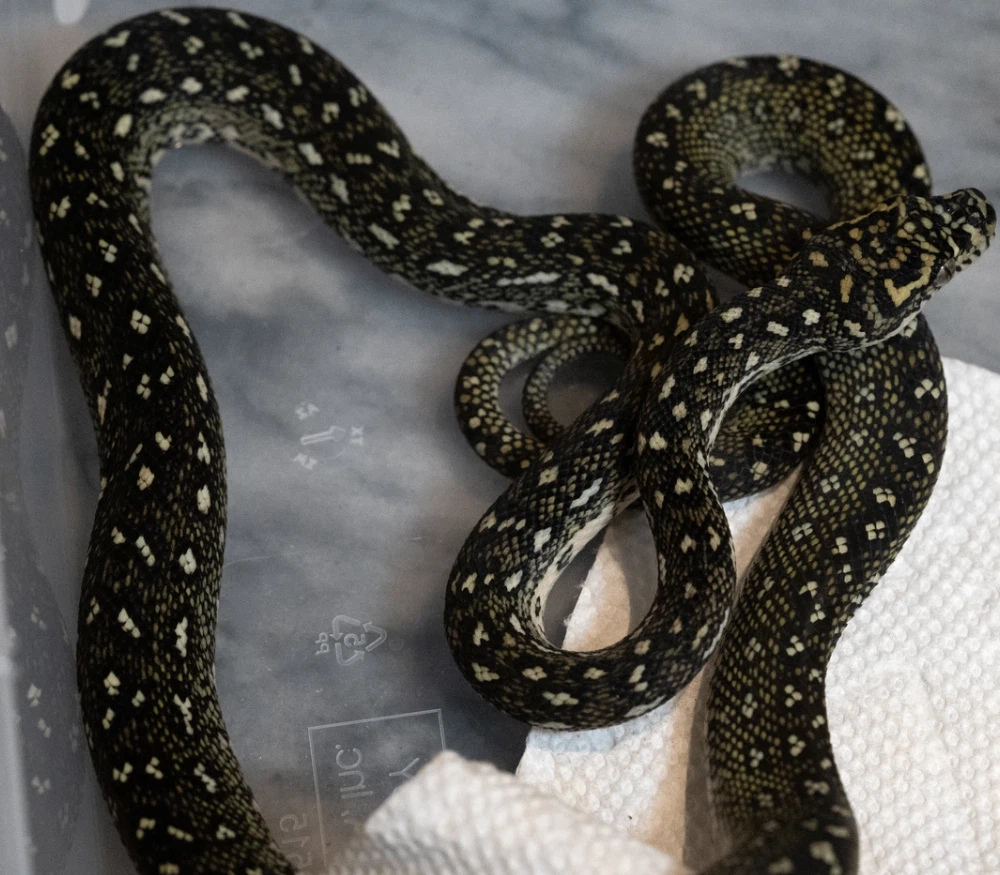
SDZ Line Diamond Carpet Python
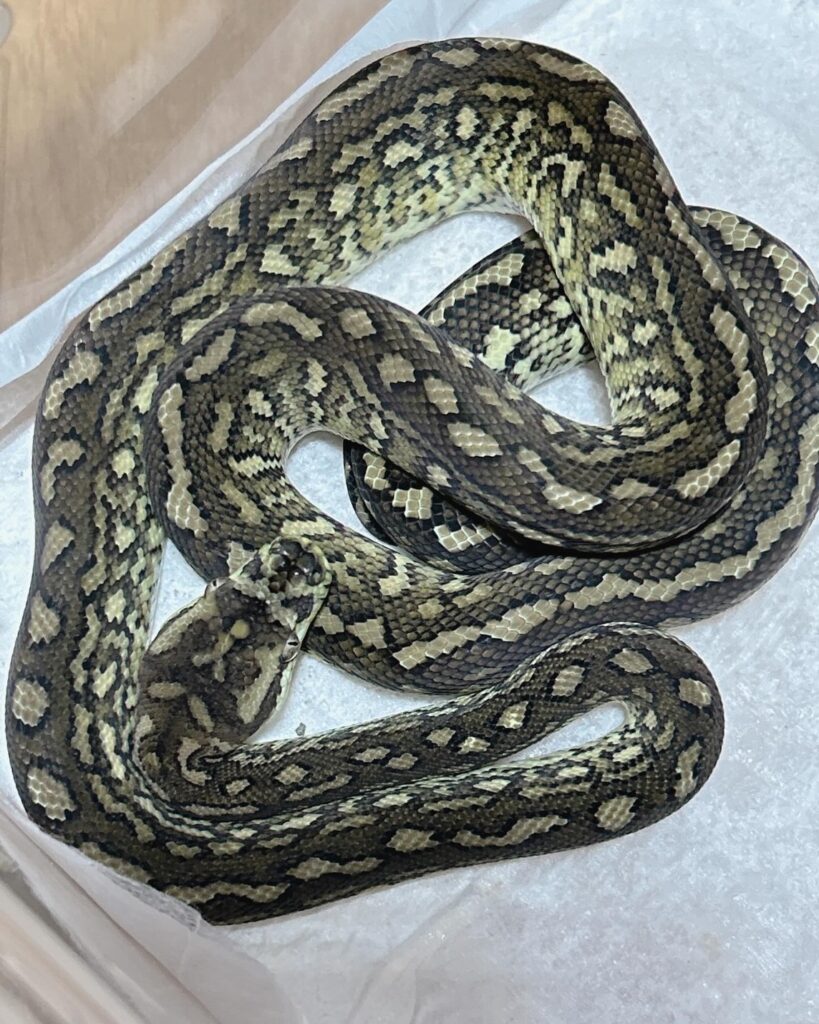
Diamond Jungle het Stonewash
MorphMarket link → Diamond Carpet Python category
Coastal Carpet Python
- Scientific name: Morelia spilota mcdowelli
- Common names: Coastal / Eastern / McDowell’s Carpet Python
- Max size: the largest subspecies. Records reach 420 cm.
- Distribution: northeastern Australia, southern New Guinea
- Lines: specific locality names are not usually attached
- Characteristics: the largest subspecies of carpet python. It grows big, is comparatively terrestrial, and most individuals are calm in their movements. Many popular morphs were produced from this subspecies.
- Notes: many major morphs — Axanthic, Jaguar, Caramel, Hypo — are Coastal-derived. A central subspecies as a foundation for morphs.
Coastal is a subspecies with a very strong terrestrial nature. I keep several Coastal-derived morphs (jaguar lines, caramel zebra lines), and rather than moving restlessly in the branches, they give a strong impression of settling on the ground. My own image of Coastal is a slightly squashed face, a thick body, a somewhat “ugly-cute” air — a large species with charm.
And above all, Coastal is the mother stock of many major morphs. Much of what is popular — Jaguar, Caramel, Axanthic, Hypo — is Coastal-derived, and that blood flows into countless mixed morphs. Because it is a subspecies that grows large, animals carrying Coastal blood do come out in size. As a foundation for the world of morphs, it is a subspecies you cannot leave out.
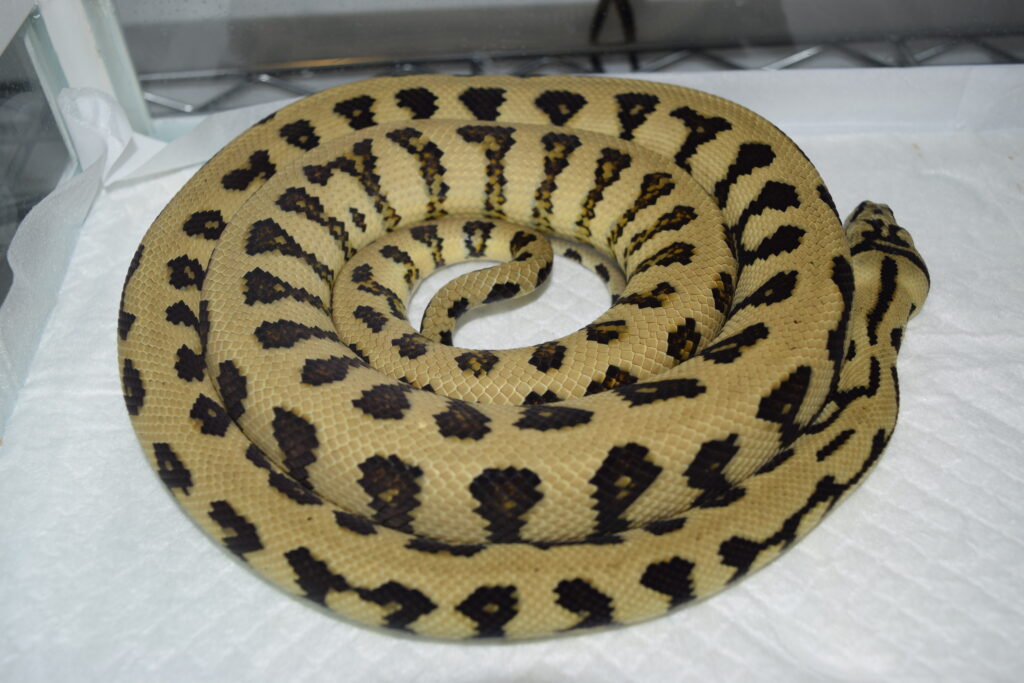
Coastal Jaguar Carpet Python
MorphMarket link → Coastal Carpet Python category
Jungle Carpet Python
- Scientific name: Morelia spilota cheynei
- Common name: Jungle Carpet Python
- Max size: around 250 cm
- Distribution: northeastern Australia
- Localities: Julatten, Archer River, Palmerston, Tully, among others
- Lines: German Blood Line (decades of selection for extreme black-yellow contrast, adults around 1.5 m and compact, color that resists fading), Scatter Shot Line, among others
- Characteristics: vivid yellow bands on a black ground — a particularly popular subspecies among carpets. Highly arboreal and very active. Temperament tends to be on the sharp side.
- Notes: the subspecies from which Zebra was produced. Locality and line divisions are discussed in comparatively fine detail.
Jungle is, in my mind, the emperor of the canopy. My own animal is often up on the climbing branch, and I feel its high arboreality day to day. That said, its temperament is hard to call gentle — try to handle it and it bites. It is a snake where the human side has no choice but to defer.
Even so, there is a reason to keep at least one Jungle. Depending on quality, it shows a yellow so beautiful it is almost absurd, one only Jungle can produce. That vivid yellow set against sharp black contrast has no substitute in other subspecies. Sharp temperament and beauty living together — that, I think, is the appeal of this subspecies.
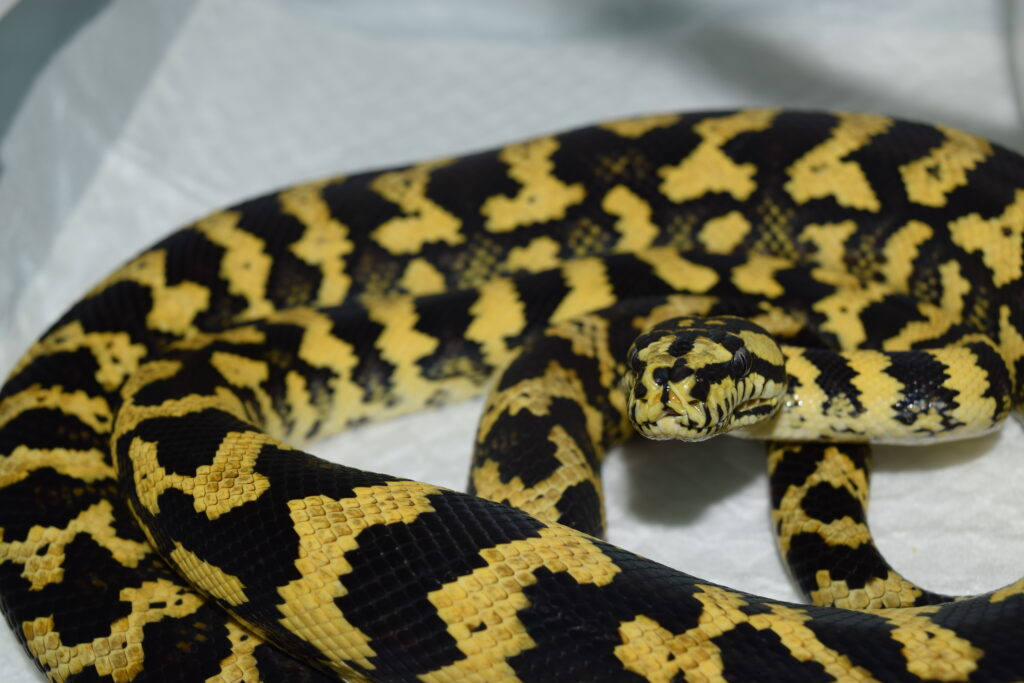
Jungle Carpet Python
MorphMarket link → Jungle Carpet Python category
Irian Jaya (Common) Carpet Python
- Scientific name: Morelia spilota variegata
- Common names: Irian Jaya / Common / Papuan Carpet Python
- Max size: around 250 cm
- Distribution: northern Australia, the West Papua (Irian Jaya) region of Indonesia
- Lines: specific locality names are not usually attached
- Characteristics: subdued coloration, somewhat strongly arboreal. Carries an understated quality favored by experienced keepers.
- Notes: the subspecies from which Axanthic and Granite were produced. Some hold it to be the same species as Darwin (harrisoni) (see the naming section).
I used to keep an Irian-derived axanthic. Irian’s black has a distinctive quality — a solid, saturated black, as if ink had been poured on. This black is a personal favorite (though the thinner, gray-tinged black of Coastal-derived animals is fine in its own right), and I think it is a charm particular to Irian.
Irian is also a subspecies rich in morph variation. As Axanthic and Granite came out of this subspecies, there is room to build combos within pure Irian alone. Being able to work up colors and patterns within Irian, without borrowing blood from other subspecies, is one of this subspecies’ pleasures. (The difference in the quality of the axanthic black is covered in detail in the Axanthic entry in the morph section.)
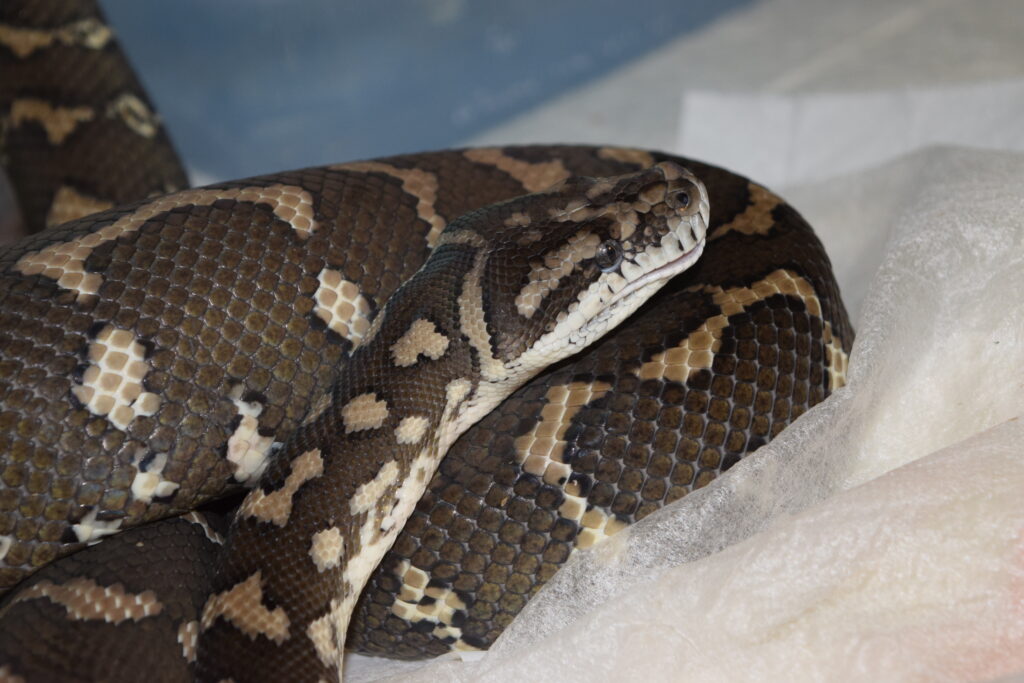
Irian Jaya Carpet Python Axanthic
MorphMarket link → Irian Jaya Carpet Python category
Darwin Carpet Python
- Scientific name: Morelia spilota harrisoni
- Common names: Darwin / Papuan / Northwestern Carpet Python
- Max size: around 200 cm (somewhat small)
- Distribution: New Guinea and its surroundings
- Lines: specific locality names are not usually attached
- Characteristics: somewhat small and easy to keep manageable. Known as the mother stock for the albino.
- Notes: the subspecies from which Albino was produced. Some hold it to be the same species as Irian Jaya (variegata). As noted, some people call it “variegata” by its scientific name.
When you say Darwin, the albino comes to mind first. This subspecies is known as the mother stock for the albino, and my own Caramel Albino (female) draws on that blood. What I feel keeping it is a small, smart impression, and an active tendency to move around a lot. In contrast to the large-growing Coastal and the like, it has a well-contained size that is easy to handle. For anyone who wants to enjoy albino-line colors, it is a foundational subspecies.
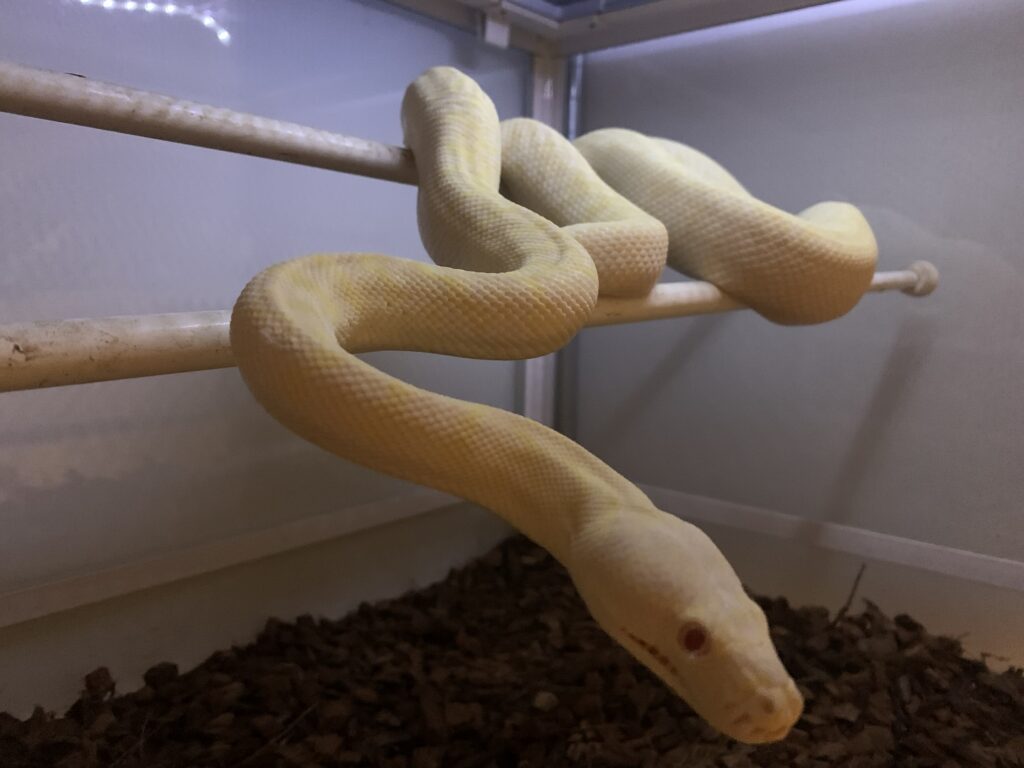
Albino Zebra Carpet Python
MorphMarket link → Darwin Carpet Python category
Inland (Murray Darling) Carpet Python
- Scientific name: Morelia spilota metcalfei
- Common names: Inland / Murray Darling / MD / Victorian Carpet Python
- Max size: around 270 cm
- Distribution: inland Australia
- Lines: generally only pure lines are traded
- Characteristics: a blue-gray and black speckled pattern. It naturally shows an axanthic color of the kind called a “natural axanthic.”
- Notes: less a matter of morphs than of the subspecies’ own coloration being prized.
I have not kept Inland, so, briefly: the appeal of this subspecies is that, without relying on morphs, the subspecies itself naturally carries an axanthic color striking enough to be called a “natural axanthic.” That the color is there from the start, not stripped out by human hands, is what makes this subspecies prized.
MorphMarket link → Inland Carpet Python category
Southern (Brisbane) Carpet Python
- Scientific name: Morelia spilota imbricata
- Common name: Southern Carpet Python
- Max size: around 250 cm (records to 400 cm)
- Distribution: western to southern Australia
- Notes: almost never traded into Japan. Information is limited.
Southern (Brisbane) is a subspecies you basically never see in Japan. I have no keeping experience with it myself, and because it rarely enters the trade, information is limited too. It is best understood as a subspecies you seldom have the chance to meet in a Japanese keeping context.
Centralian (Bredl’s) Python
- Scientific name: Morelia bredli
- Common names: Centralian Python / Bredl’s Python
- Max size: grows large
- Distribution: inland Australia, especially the central region
- Characteristics: a reddish-brown ground color with cream bands edged in black. As it grows, the red comes into its own — a beauty.
- Notes: strictly speaking not a carpet python (M. spilota) but a separate species (M. bredli). Even so, in keeping and the trade it is often handled together as one of the carpet crowd. Stonewash and others have been produced from it.
Centralian is, strictly speaking, not a carpet python (Morelia spilota) but a separate species (Morelia bredli). Even so, in keeping and the trade it is often treated as one of the carpet crowd, and I too keep a Centralian (female) lined up among my carpets.
The appeal of this snake is, above all, the red. It is the only one of the carpet crowd to carry a clear red, and as it grows the reddish-brown ground comes into its own. Until a few years ago it was treated as a premium snake on a par with Diamond, but in recent years the price has settled. I have raised mine from a baby, and one striking thing is just how fast it grows. A separate species that has folded naturally into the carpet world — a snake with a distinctive position, I think.
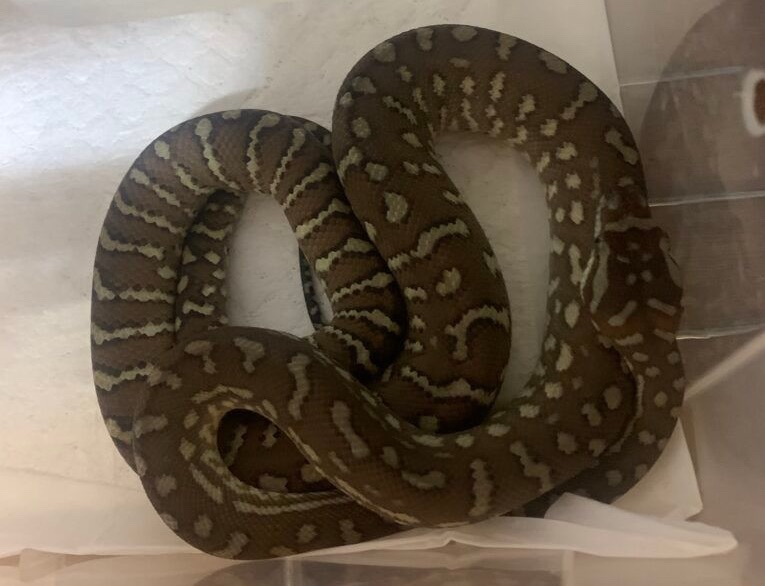
Bredl’s Python
MorphMarket link → Bredl’s Python category
Morphs by Inheritance
With the subspecies covered, we move on to morphs. As explained in the naming section, morphs get confusing fast when you sort them by name, so here they are organized by inheritance. Grouping them by how they inherit, rather than by what they are called, is the one axis that keeps you from getting lost in this world.
One point about carpet pythons as a whole first. Morph inheritance is usually split into three broad types: dominant, co-dominant, and recessive. When it comes to carpet pythons, though, an established dominant morph — one where making a super form (homozygous) produces no visible change — is hard to find, at least among commonly available lines. The major visible morphs are all co-dominant, and their super forms look like something else entirely. So this section drops the dominant category and works with just two: co-dominant and recessive. (If anyone has solid information on an established dominant carpet morph, I would genuinely like to hear it.)
Co-dominant Morphs
A co-dominant trait shows even in the heterozygous state (one copy), and changes again in the super form (homozygous, two copies). Many of the popular carpet python morphs fall here.
There is one point that is hard to see until you have actually bred these animals. Even within co-dominant morphs, there are two different ways the super form can turn out.
In the first type, the super form is nothing like an extension of the heterozygous animal — it becomes a completely different look. Zebra becomes patternless in its super form, the stripes gone. Jaguar in its super form goes nearly white in a leucistic direction (and dies at a high rate). Looking at the heterozygous animal, you cannot really picture where the super form will land.
In the second type, the super form simply intensifies the direction the heterozygous animal was already heading. Caramel and Hypo work this way: both reduce black pigment and push toward yellow, and the super form shows more of that same shift. It reads as a straightforward extension of the het.
This difference quietly matters when you are trying to predict what a pairing will produce. Rather than lumping everything together as “co-dominant,” knowing which of the two types a morph belongs to changes how you approach breeding for the super form.
Jaguar
- Inheritance: co-dominant (the “becomes something else” type)
- Appearance: the pattern breaks up, and the saddle markings turn into the distinctive jaguar look. Many individuals show strong yellow, and it is a very popular morph.
- Super form: the super jaguar takes on a nearly white, leucistic-like appearance, but is considered lethal at a high rate (see the super-form note below).
- A caution: jaguar is said to carry a neurological condition, “wobble,” as part of the gene. The degree varies between individuals, but because it is tied to the jaguar gene itself, fully separating the two is said to be difficult. The details are covered in a separate article on wobble, but it is something to know before buying.
Among the animals I keep, an Ocellot Jaguar (male) and a Caramel Zebra Jaguar het Axanthic (female) carry this trait. In breeding, I was able to produce a beautiful Caramel Zebra Jaguar.
On temperament first: jaguar is a Coastal-derived morph, and perhaps reflecting that blood, the animals grow large and tend to be relatively calm. My own animals match that impression.
The amount of black reduction varies a lot between individuals. Even among jaguars, how far the pattern breaks up and how much yellow comes through differs from one animal to the next. Even jaguar siblings show different pattern disruption one by one, and that is part of the fun.
On wobble, let me give my honest experience. My jaguars do show wobble. But as long as the degree is not severe, it rarely causes problems in daily life. A reptile’s health, when you get down to it, comes down to whether it can eat — that is how I see it. And a story of wobble severe enough to interfere with feeding is something I have almost never heard. So the presence of a neurological symptom, in itself, is not something to fear more than necessary, in my view. (Wobble itself is covered in detail in a separate article.)
One last note on breeding. Jaguar pairs well with other morphs and is versatile, but its super form (super jaguar) is lethal at a high rate. That also means that if your collection fills up with jaguars, you can end up in a situation where crossings do not leave you healthy offspring. Precisely because it is a convenient morph, the balance of the whole collection is worth keeping in mind. And still — jaguar is just cool. That is the honest feeling of someone who keeps them.
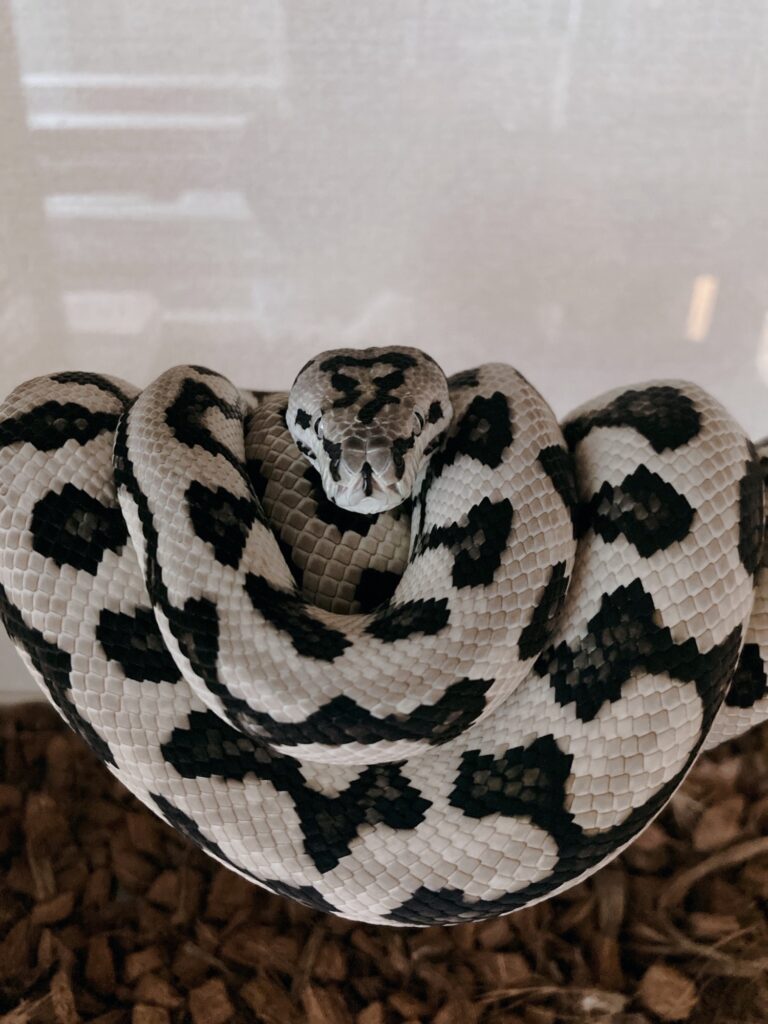
Axanthic Jaguar Carpet Python
MorphMarket link → Jaguar trait search
Zebra
- Inheritance: co-dominant (the “becomes something else” type)
- Appearance: Jungle-derived. A striped (zebra) pattern.
- Super form: the super zebra becomes patternless. Not an extension of single zebra — the stripes disappear into a different look.
- Note: the change when combined with Axanthic, Albino, or Caramel is large, making it popular as a base for combos (see the combo section).
I keep several animals that carry zebra, including Axanthic Zebra and Caramel Zebra. The appeal of zebra lies less in the stripes it shows on its own and more in its usefulness as a combo base. The change when layered with other traits is large, and it becomes the starting point again and again when I think through a breeding plan. Longer term, I want to build around a super-form version of this zebra (the specific plan comes up in the combo section).
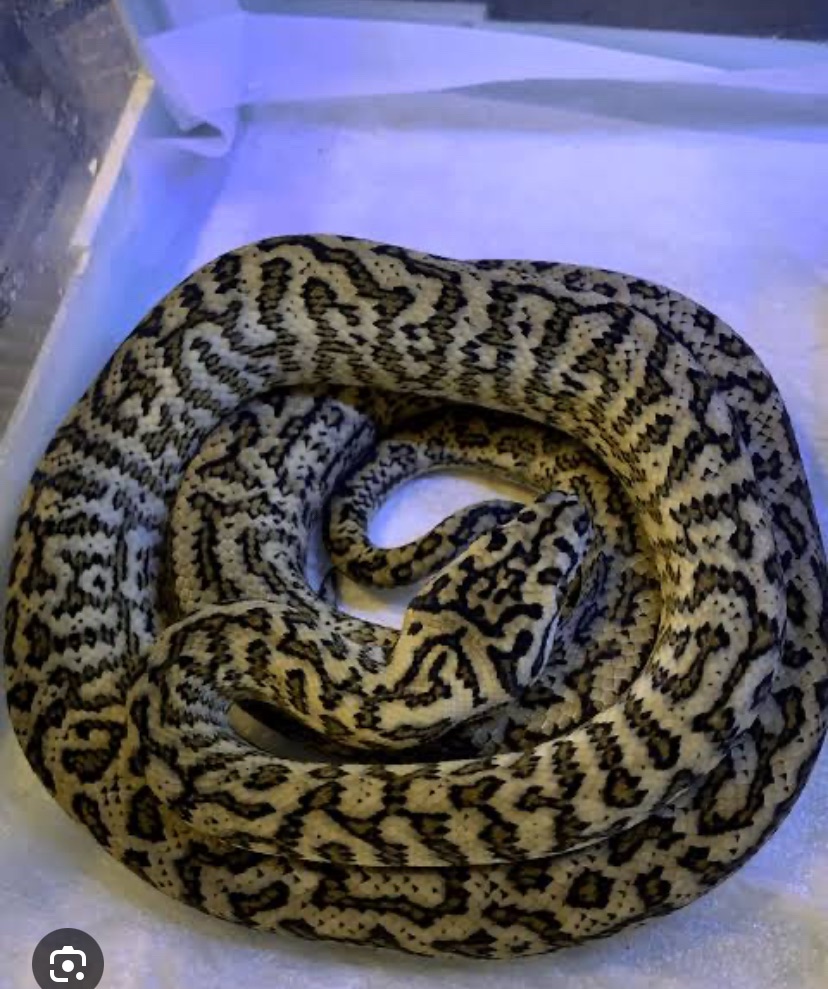
Caramel Zebra Carpet Python
MorphMarket link → Zebra trait search
Caramel
- Inheritance: co-dominant (the “intensifies” type)
- Appearance: the black areas lighten, and a caramel color (a warm yellow-to-brown) comes over the whole animal. A brighter impression than a normal.
- Super form: the super caramel loses more black pigment and gains more yellow, so the “caramel color” quality becomes clearly stronger. It is an extension of the het’s direction. Because yellow increases, it becomes a starting point for adjustments — pushing yellow further with jaguar, or stripping that yellow out with axanthic.
- Note: excellent as a color-adjusting part in combos.
Among my animals, a Caramel Zebra (male) and a Caramel Albino (female) carry this trait. In practice, caramel is a morph that is “easy to read on its own, but difficult in a combo.” Single caramel has a distinctive warm color that is easy to identify. But once it is combined with other traits, it can be hard to tell whether caramel is in there or not. The baby stage is especially tricky: freshly hatched animals often carry a reddish tone to begin with, and telling whether that red comes from hatch color or from caramel is hard. You end up unsure until the animal grows and the color settles.
Even so, caramel clearly adds interest to both pattern and color. It works like laying one coat of warm yellow-to-brown over the animal, and I rely on it as a part for tuning the final color of a combo.
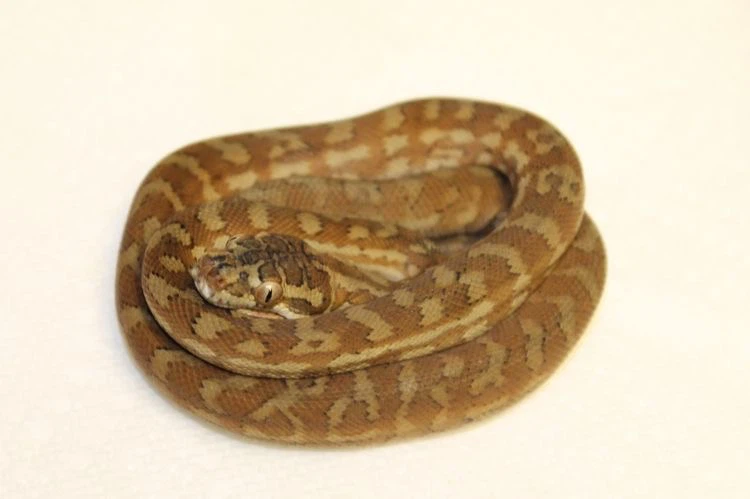
Caramel Carpet Python
MorphMarket link → Caramel trait search
Hypomelanistic (Hypo)
- Inheritance: co-dominant (the “intensifies” type). The inheritance was debated in the past, but in recent years it is treated as co-dominant.
- Appearance: black pigment is reduced, giving a brighter, clearer overall impression. Like caramel, a shift in the “less black, more yellow” direction.
- Super form: a brighter animal that strengthens the het’s direction (the intensifying type).
- Note: the word “hypo” covers a wide range, and it easily becomes an example of the “same name, different thing” problem discussed in the naming section. The inheritance is co-dominant, but the naming needs care.
I have not kept hypo, so this is only an impression from what I have seen. A super hypo pulls the black out well and becomes cleanly bright. If you picture something like a ball python Banana — black receding, color clearing — you are close. Because it is in the same “reduce the black, bring out the yellow” family as caramel, it looks similar, and the two do get confused in practice (this naming tangle comes up again in the naming and combo sections).
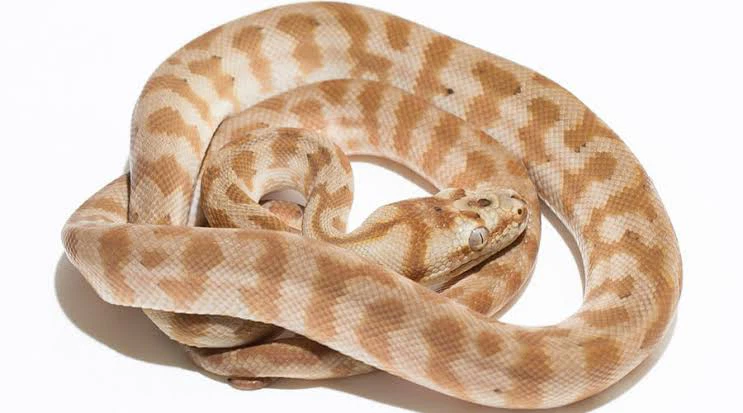
Hypo Carpet Python
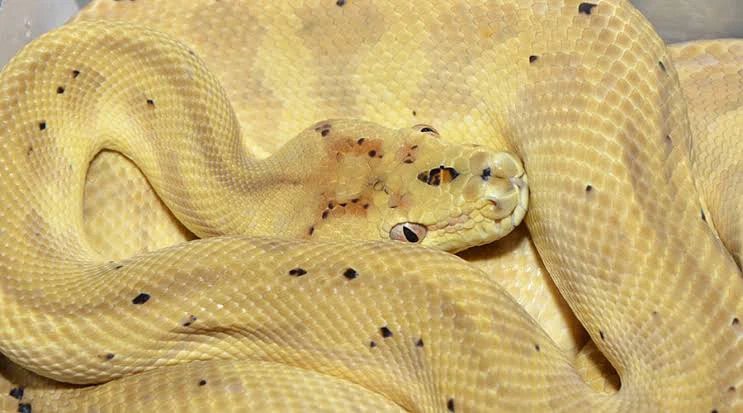
Super Hypo Carpet Python
MorphMarket link → Hypo trait search
Recessive Morphs
A recessive trait does not appear unless the animal inherits one copy from each parent and becomes homozygous. A heterozygous (het) animal looks normal but carries the gene. That is why “het notation” matters in breeding recessive morphs (het notation is covered in detail in the combo section). Because it does not show visually, the question becomes whether you can trust the lineage information.
Albino
- Inheritance: recessive
- Appearance: melanin (black pigment) is absent, so black drops out. In reptiles, yellow and red pigments remain, giving a white ground with yellow-to-orange over it (unlike mammalian albinos, reptile albinos are easy to identify). The eyes turn red.
- Note: the Darwin-derived albino is well known. Quality shifts with T+/T− (the presence or absence of tyrosinase).
Among my animals, I keep a Caramel Albino (female). What I feel with albino is that the difference in quality is enormous. Some individuals show strong red; others have the pattern collapse until the whole animal is a single cream color. Even within one “albino,” the range of outcomes is wide.
Albino is also a strong-acting trait. Even when combined with other morphs, the albino expression can push so far forward that the traits underneath become hard to read. Turned around, that is how much presence it has, and a clean albino is genuinely dreamlike in its beauty. The satisfaction of meeting one such animal is something particular to this morph.
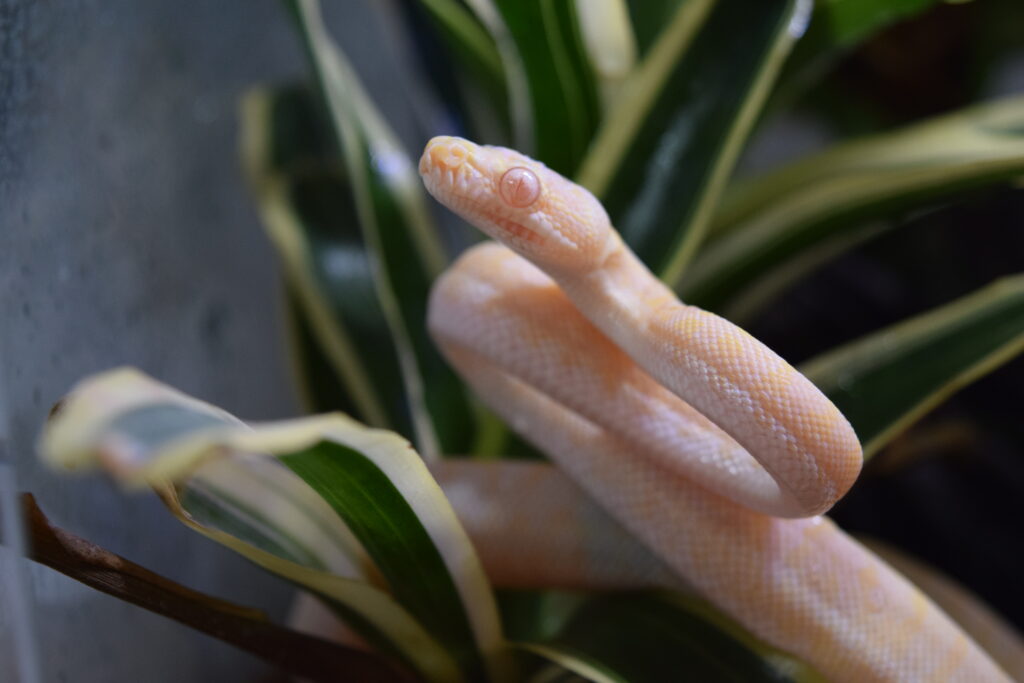
Albino Zebra Carpet Python
MorphMarket link → Albino trait search
Axanthic
- Inheritance: recessive
- Appearance: yellow and red pigments are reduced, shifting toward monotone (silver-gray to black-and-white). A morph in the opposite direction from albino.
- Note: Inland is called a “natural axanthic,” the subspecies itself carrying an axanthic color. Combined with albino, it makes the Snow line.
Axanthic is, in Japan, probably one of the most popular morphs — I would say that safely. It pairs well with other morphs, and personally I especially like combinations like Axanthic Jaguar and Axanthic Zebra. I keep an Axanthic Zebra, and I also have het Axanthic animals.
Here is something well known among keepers in Japan but rarely seen in English-language guides. Axanthic comes in a Coastal-derived form and an Irian Jaya-derived form, and the “quality of the black” differs between them. Irian-derived axanthic has a solid, saturated black, as if ink had been poured on. Coastal-derived axanthic, on the other hand, has a thinner, gray-tinged black. Both are beautiful in their own way, but personally I prefer the Irian’s dense black.
Knowledgeable keepers in Japan, and I myself, can look at an axanthic animal and roughly tell whether it is Coastal-derived or Irian-derived. So, out of pure curiosity — do keepers overseas distinguish this origin difference? And one more: if you crossed a Coastal axanthic with an Irian axanthic, what would happen to the quality of the black? Would it land somewhere in the middle, or lean to one side? I do not have an answer to this myself. If anyone has thought about the same thing, I would love to hear it.
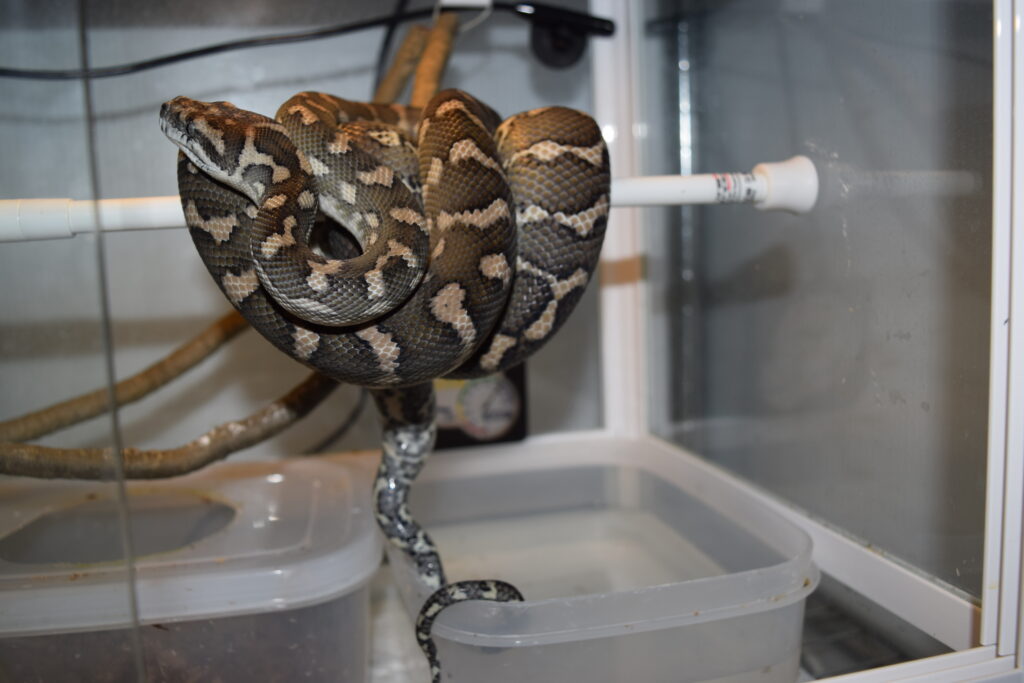
Axanthic Carpet Python
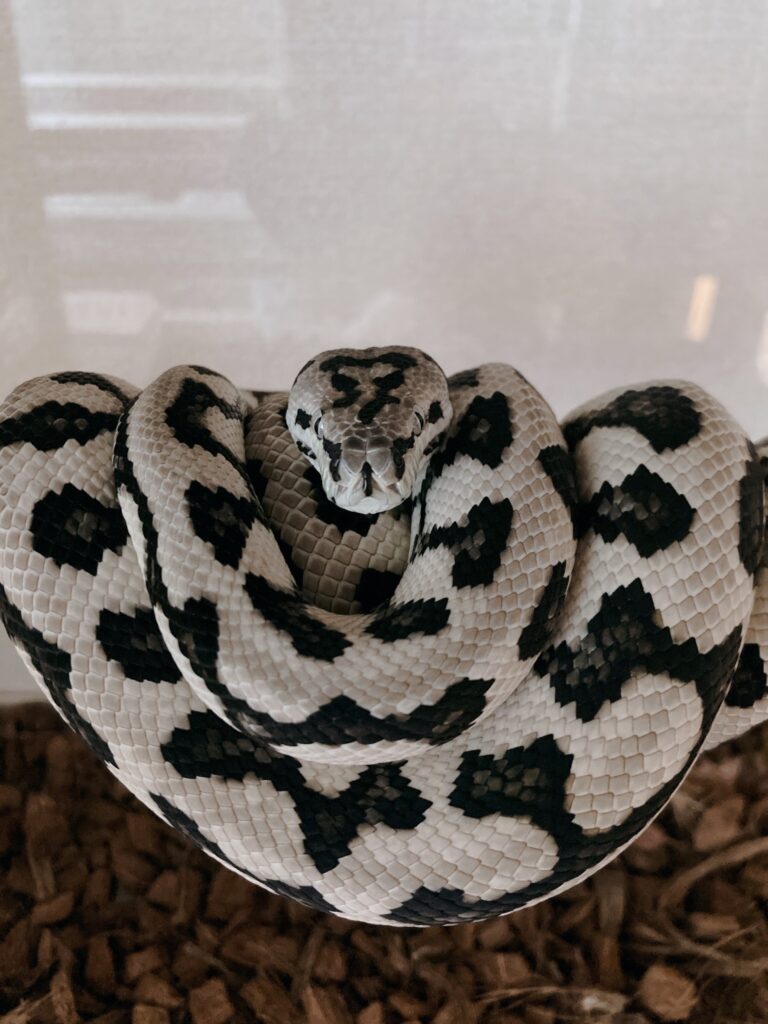
Axanthic Jaguar Carpet Python
MorphMarket link → Axanthic trait search
Granite
- Inheritance: recessive
- Appearance: a fine speckled (granite-like) pattern. Irian Jaya-derived.
- Note: recessive combos (Axanthic Granite and the like) are talked about as objects of aspiration.
I do not keep granite itself, but recessive combos like Axanthic Granite and Snow are spoken of among keepers as things to aspire to.
That said, there is one question about granite that has nagged at me for a long time. It is not something I can state as fact, so let me write it honestly as a question. When you look at an Axanthic Granite (axanthic × granite), yellow sometimes appears to come back. This is what puzzles me. Axanthic is supposed to be a recessive morph that reduces yellow and red pigment, and with axanthic on the animal, the yellow ought to be gone — shouldn’t it? And yet, combined with granite, the yellow seems to return. What is more, something that seems related: the banding on Irian Jaya animals is sometimes not a flat single tone but carries a gradient. I have a feeling this phenomenon and the yellow re-emergence in Axanthic Granite are connected somewhere.
This is a plain question based on my own observation, and I do not have the answer. Even within Japan, I have never heard a clear explanation of this point. If anyone knowledgeable about pigment mechanisms, or anyone who has noticed the same phenomenon, could tell me, I would be grateful. I would like to make this article a place where questions like this can gather.
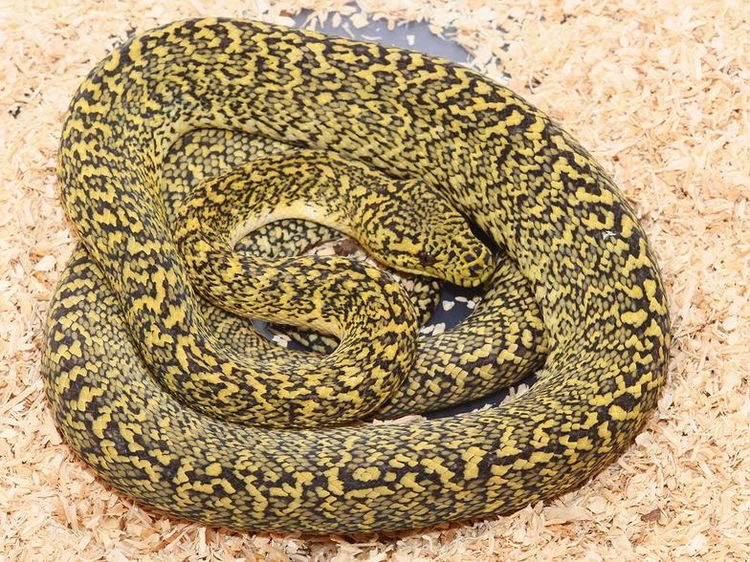
Granite Carpet Python
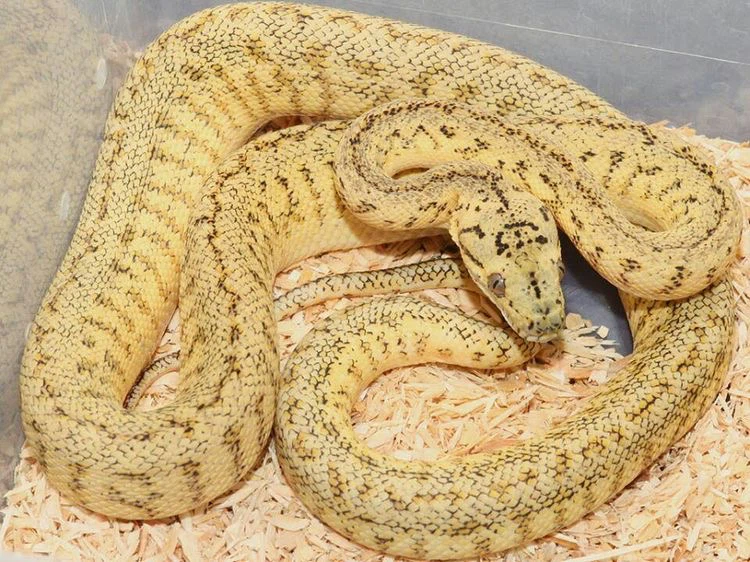
Granite Jaguar Carpet Python
MorphMarket link → Granite trait search
On Super Forms and Leucism (a note)
Let me add a little more on the “becomes something else” type mentioned in the co-dominant section — specifically the ones that go in a whitening direction. If you breed carpets, this is unavoidable.
Leucism (whitening) and albinism (loss of black) are different phenomena. Albino is a morph where black pigment drops out; leucism is a whitening action, and because leucism retains the black pigment itself, the eyes are often black. In other species, several cases are known where the super form becomes leucistic, but the whitening line confirmed in carpets is roughly just the super jaguar (lethal at a high rate), and compared to other species, the variety of whitening is limited.
And the fact that super jaguar tends to be lethal bears directly on breeding plans. Pairing jaguar to jaguar produces super jaguar in one out of four in theory, but in most cases they do not survive. Jaguar breeding has to be done with that premise understood.
Honestly, the wish to see a leucistic carpet at least once is something I cannot quite let go of. Carpets are poorer in whitening lines than other species, but there are cases where a leucistic-like expression has shown up in Lucy and paradox animals. If so, then given the right set of conditions, maybe a leucistic expression could be made in carpets too — or so I think. But this is not a claim with firm grounds; I write it as one keeper’s speculation and wish.
Why Are Morph Names This Complicated
Before getting into the individual morph write-ups, one thing about names. It would be convenient if carpet python morph names split neatly by region — US vs Europe vs Australia. In practice they do not. Naming variation comes less from region than from breeder lines, from the namer who produced the animal, and from market convention.
Concretely, this is the sort of thing that happens daily. The same trait gets called by different names line to line. Conversely, the same name refers to genetically different things. One thing has several names — some people treat Irian Jaya, Common, and Darwin as all the same, others separate them strictly, and which is correct shifts with the seller’s position. On top of that, some people even call a Darwin “variegata” (variegata) by its scientific name. They are presumably aiming for precision, but the person on the receiving end is left converting a conversation where common names and scientific names run mixed together. Honestly, it is exhausting.
Two things sit at the root. One is that the subspecies classification itself is still unsettled (the Irian Jaya / Darwin same-species question, discussed later, is one example). The other is that most morph names were attached to the “look” before the genetics were worked out. The name comes first, and the genetic understanding catches up afterward. Given that order, it is only natural that names and genetics do not correspond one to one.
So the practical conclusion is one thing. Do not take names at face value; read by phenotype and, where possible, by genetic information (what the parents carry, what the het notation says). A trustworthy breeder can explain in genetic terms and will add a caveat like “in this line we call it this.” A name is a convenient label, but a label does not guarantee the contents. The reason the following sections arrange morphs by inheritance mode is that this is the one axis not thrown around by the drift of names.
Combo Morphs and How to Read the Names
So far we have looked at single morphs. In practice, most animals in the trade are “combo morphs,” several of these combined. A long name like “Caramel Zebra Jaguar” is just single morphs added together. The name may look like an incantation, but once you know the rule for taking it apart, you can read it.
A combo name is a list of the traits it carries
A combo morph’s name is basically a list of the traits the animal carries. “Caramel Zebra Jaguar” means it carries the three: Caramel, Zebra, and Jaguar. The order is set somewhat by convention, but there is no strict rule, and the arrangement can move around breeder to breeder (this too is an instance of the “names drift” point from the naming section).
So the trick to reading is to break the name into words and match each to a trait from the morph section. With practice, you can start to predict “with this name, it should look like this and carry this genetics.”
Reading het / poss het notation
Unavoidable in understanding combos is the “het” notation. Het is short for heterozygous, and it refers to carrying one copy of a recessive trait (not showing it visually).
For example, “Caramel Zebra Jaguar het Axanthic” means Caramel, Zebra, and Jaguar are showing visually, while Axanthic (recessive) is carried in the genes but not showing.
Worth distinguishing are confirmed het and poss het (possible het).
- 100% het (confirmed het) … definitely carries that recessive gene. Used when it can be confirmed from the parent combination.
- 66% poss het / 50% poss het, etc. … poss het is short for “possible het,” meaning it might carry it (a probability). Used when it cannot be told visually and is not confirmed until you actually breed the animal. The number is the probability, calculated from the parent combination, that the animal is het. In notation it is sometimes abbreviated phet.
Here is the important part: het and poss het only mean something once you can trust the lineage information. Because it does not show visually, there is a portion where you have no choice but to believe the seller’s declaration. In recessive combos especially, buying from a trustworthy breeder, together with grounded lineage information, matters.
Combos whose contents you cannot read from the name (an alias dictionary)
Among combos, there are those whose makeup you can see from the name, like “Caramel Zebra,” and those where hearing the name tells you nothing about what is combined with what. The latter you just have to memorize, so here are the major ones. These are nicknames attached to combinations of the “strip color / whiten” traits — Hypo, Albino, and Axanthic.
| Alias | Makeup |
|---|---|
| Snow | Albino + Axanthic |
| Ghost | Hypo + Axanthic |
| Sunglow | Hypo + Albino |
| Moonglow | Hypo + Albino + Axanthic (a triple combo) |
As you can see, the name changes with how Hypo, Albino, and Axanthic are combined. Moonglow is all three at once, and is considered especially white and rare among carpets.
One caution to add. Hypo and Caramel are separate morphs that both reduce black pigment and read as brighter, and they look alike. Because of that, a Ghost or Sunglow that should be made with Hypo sometimes gets the same name when made with Caramel instead (strictly, a Caramel Axanthic is not a Ghost, and so on). It is also an area handled differently by different people, so here I will just note that “similar morphs get their names confused easily.”
An aside on the name “Hypo”
While we are here, one more example of how the name “Hypo” has gotten tangled. Before Hypo was fixed as a morph, there was a period when black-light individuals of the Centralian (Bredli) were called “Hypo.” As a remnant of that, animals under the name “Hypo Centralian” still turn up in the trade sometimes. These have a different origin from what is now established as the Hypo morph. It is one example of a name dragging along its past history — a concrete case of the “names drift on the accidents of history” point from the naming section.
What combining lets you do
The fun of combos is being able to mix traits like paints and go after a color you are aiming for. You put a color-adding trait like Caramel and a color-stripping trait like Axanthic on the same animal, and control the final phenotype. With the single-morph knowledge from the morph section, you can start to sketch a rough finished picture just from seeing a combo name.
Let me talk through this appeal using my own breeding goal as an example. For a long time now, I have wanted to make a single animal: a Super Caramel Super Zebra Axanthic. The plan is to make both Caramel and Zebra into super forms (homozygous), and layer recessive Axanthic on top.
Put into words it is one line, but actually making it is a long road. Producing super forms requires gathering the target co-dominant trait from both parents, and making recessive Axanthic homozygous requires confirming and stacking hets — which do not show visually — over many generations. It is the work of getting the super form of a co-dominant and the homozygous form of a recessive to hold true on the same animal at the same time. Honestly, I hold it as a long-term goal, the kind of thing where it would be enough if I could manage it before I die.
But that “distance” is exactly what makes combo breeding interesting. If you understand the inheritance modes of the single morphs, you can see which parents to pair to step one closer, and where you will stall. Closing in on the finished picture a little more each generation — that process itself is the deepest pit of this hobby.
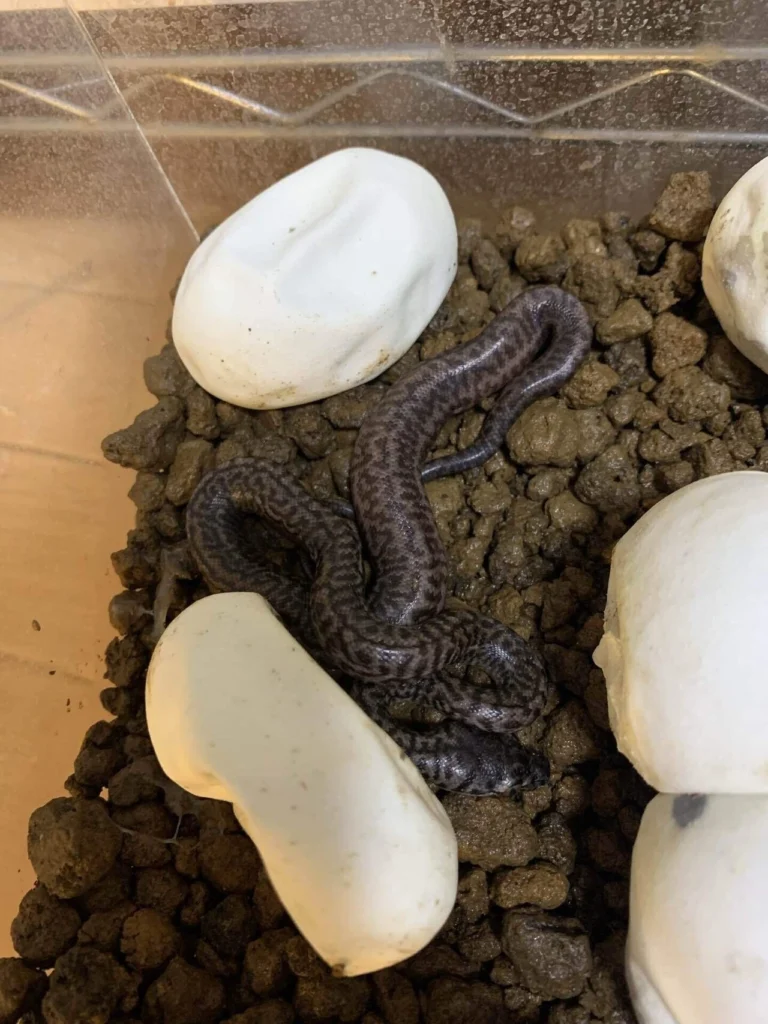
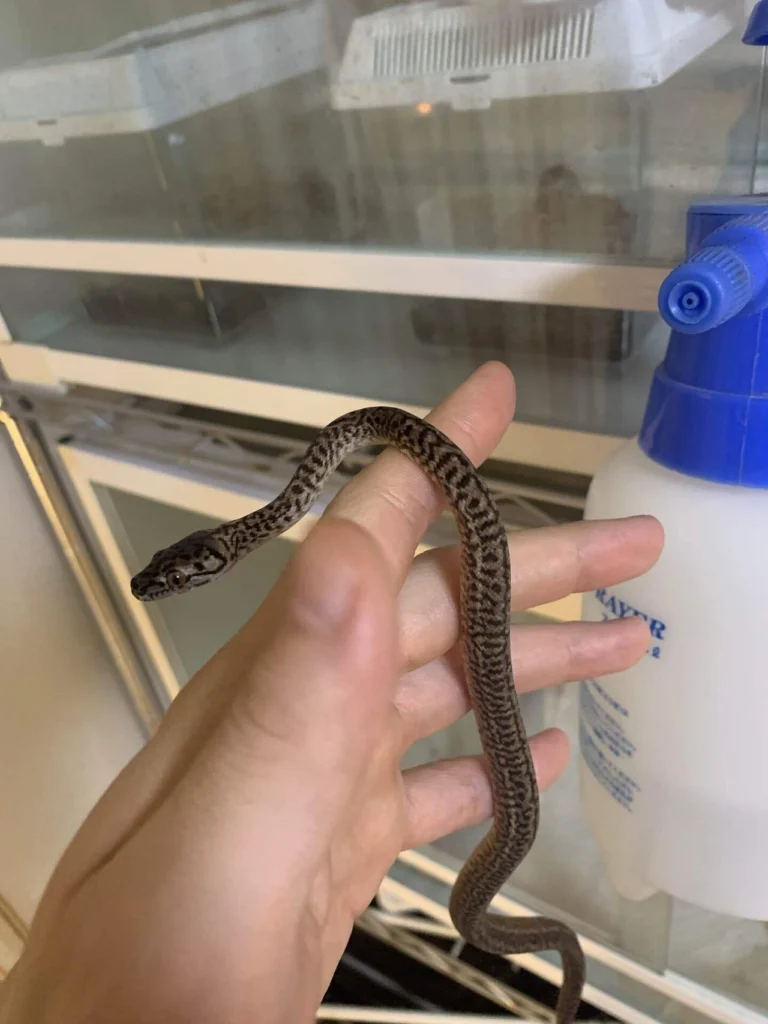
beautiful Caramel Zebra Jaguar that was produced
Running the numbers yourself
The genetic math of a combo (pair which parents and what comes out at what probability) can be written out by hand, but MorphMarket’s Genetic Calculator is faster. Enter the traits the parents carry and it returns the offspring phenotypes and probabilities. It supports carpet pythons too, so it is handy for breeding plans and for checking “is this offspring even possible from these parents.”
MorphMarket link → Carpet Python Genetic Calculator
We have worked through the localities and morphs of the carpet python. That said, I do not think this is everything.
The classification and the morph world of this species are still moving. New lines get made, ideas about subspecies get revised, things long held to be separate turn out to be the same, and the reverse happens too. So this guide is less a finished product than a record of where things stand right now. Whenever I learn something, I intend to update it.
If there is an error in this article, information that is missing, or a “in my line we call it this / we have this case” story, I would be glad to hear it. When it comes to locality and line naming especially, the accurate picture only comes into view through the accumulation of examples each keeper holds. I would be happy to make this guide one of the places where that kind of information gathers.
In Japanese, I also write about reptiles on note (note.com/limbor55_rptr). Breeding records for carpet pythons and keeping records for other species are over there. If you read Japanese, take a look if you like.
Until next time.